Multiple Choice
Passage
Physical activity produces an increased energy requirement in the muscles as well as in the brain. During periods of intense exercise, glycogenolysis is activated in muscles to provide them with the energy needed for contractions, and research indicates that astrocytes also consume glycogen at increased levels during exercise. It is hypothesized that during periods of physical exertion, astrocytes convert glycogen to lactate, which is then used as a fuel source in neurons.Monocarboxylate transporters (MCTs) are responsible for the movement of lactate across membranes, and MCT2 is expressed at increased levels in neuronal cells during exercise. Scientists proposed that lactate is secreted from astrocytes and taken up by neurons through MCT2. Lactate is then converted to pyruvate and enters the mitochondria, where it is further metabolized. To test their predictions, scientists examined the effect of exercise on glycogen metabolism in rodents.Experiment 1Rats were either allowed to rest or exercised to exhaustion. The levels of several metabolites were then quantified in both the plantaris muscle and the hippocampus.
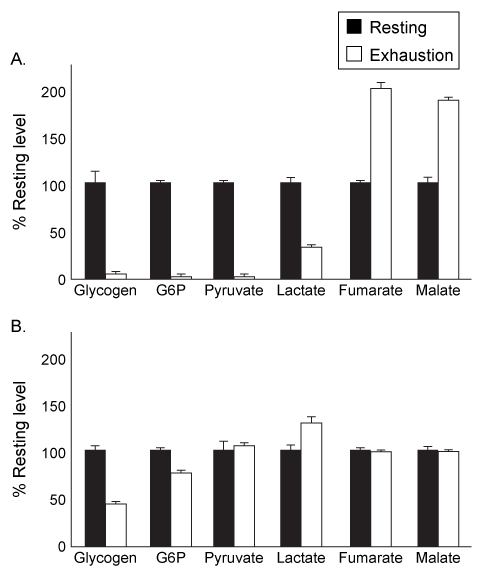 Figure 1 Levels of several metabolites in plantaris muscle (A) and hippocampus (B) from rats at rest or after exercising to exhaustionExperiment 2Rats were injected with 1,4-dideoxy-1,4-imino-D-arabinitol (DAB) or saline, and glycogen and lactate levels were measured in the hippocampus of rats at rest or after exercise to exhaustion.
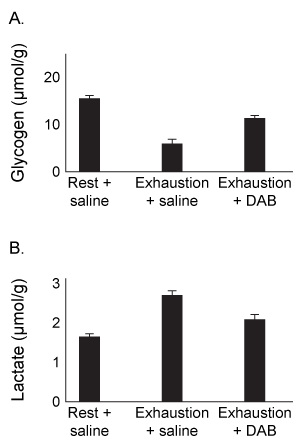 Figure 2 Levels of glycogen (A) and lactate (B) in rats injected with DAB or saline, after rest or upon exhaustion
Adapted from Matsui T, Omuro H, Liu Y-F, et al. Astrocytic glycogen-derived lactate fuels the brain during exhaustive exercise to maintain endurance capacity. Proceedings of the National Academy of Sciences. 2017;114(24) :6358-6363.
-Assuming the proposed mechanism in the passage is correct, what is the fate of the carbon atoms in lactate after they pass through MCT2 channels?
A) They will be stored as triacylglycerides.
B) They will be converted into glucose.
C) They will be incorporated into neuronal glycogen stores.
D) They will be released as CO2.
Correct Answer:

Verified
Correct Answer:
Verified
Q149: Passage<br>Many lysosomal proteins are transported to the
Q150: Passage<br>Ribulose-1,5-bisphosphate carboxylase/oxygenase (rubisco) is one of the
Q151: Which statement correctly describes the cleavage of
Q152: Passage<br>Many cephalopods can change color to blend
Q153: Passage<br>Whole grains have been shown to reduce
Q155: Passage<br>Synthesis of coenzyme A (CoA) requires vitamin
Q156: Which of the following molecules could decrease
Q157: Researchers isolate a protein that runs as
Q158: Passage<br>Many lysosomal proteins are transported to the
Q159: Passage<br>Oxidative stress occurs in cells when reactive