Multiple Choice
Passage
A newborn girl is diagnosed with a rare genetic disorder that causes premature lysis of red blood cells. Through genome sequencing, physicians identified a specific mutation (R510Q) in both copies of her pyruvate kinase gene, which encodes the enzyme that catalyzes the final step of glycolysis. Pyruvate kinase produces pyruvate and ATP from phosphoenolpyruvate (PEP) and ADP.PEP + ADP ↔ Pyruvate + ATPReaction 1Because red blood cells lack mitochondria, pyruvate in erythrocytes does not enter the citric acid cycle and the electron transport chain. Therefore, red blood cells rely almost exclusively on glycolysis to produce sufficient ATP for cellular functions. In patients with pyruvate kinase deficiency, it is thought that a lack of ATP compromises the integrity of the red blood cell membrane, leading to premature lysis in the spleen. Although these observations are well established, the exact mechanism by which low ATP alters the cell membrane is unclear.Scientists interested in analyzing this particular patient's gene variant expressed and purified recombinant R510Q pyruvate kinase. They performed several biochemical tests to characterize the R510Q mutant with respect to wild-type (WT) pyruvate kinase. In the first experiment, WT and R510Q pyruvate kinases were each incubated with a constant amount of ADP and varying amounts of PEP. The activity of the enzyme was measured at each concentration of PEP and plotted. They then repeated the experiment in the presence of ATP and found that ATP is a noncompetitive inhibitor of the WT enzyme, but a mixed inhibitor of the R510Q enzyme. The results are shown in Figure 1. All experiments were done at the same enzyme concentration.
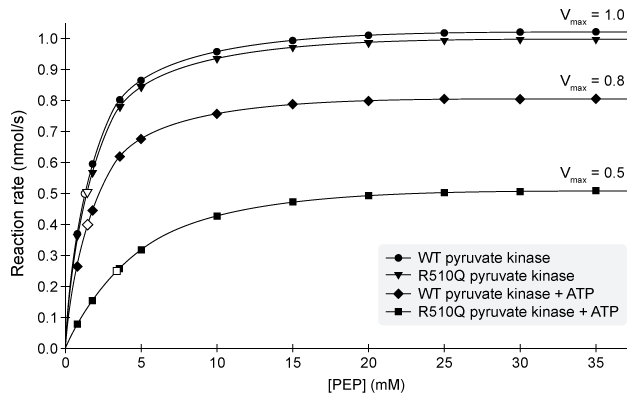 Figure 1 Pyruvate kinase activity with and without ATP as a function of [PEP]. Open markers are shown at ½Vmax for each plot.
Adapted from Wang C, Chiarelli LR, Bianchi P, et al. Human erythrocyte pyruvate kinase: characterization of the recombinant enzyme and a mutant form (R510Q) causing nonspherocytic hemolytic anemia. Blood. 2001;98(10) :3113-20.
-Given that pyruvate synthesis is generally unidirectional, which of the following statements regarding the thermodynamics of Reaction 1 is most accurate?
A) The enthalpy change is positive.
B) The enthalpy change is negative.
C) The net free energy change is positive.
D) The net free energy change is negative.
Correct Answer:

Verified
Correct Answer:
Verified
Q219: Passage<br>The sirtuins are a class of enzymes
Q220: Passage<br>The cystic fibrosis transmembrane conductance regulator (CFTR)
Q221: Researchers measured the activity of two enzymes
Q222: Which event could alter a protein's primary
Q223: Passage<br>Oxidative stress occurs in cells when reactive
Q225: During prolonged fasting, which of the following
Q226: Passage<br>ATP synthase, also known as Complex V,
Q227: Passage<br>Destabilase, an enzyme found in the saliva
Q228: Passage<br>The recent advent of multidrug-resistant Mycobacterium tuberculosis
Q229: Passage<br>The bacterium Clostridium difficile secretes protein toxins