Passage Presynaptic Nerve Terminals Release Neurotransmitters Via Synaptic Vesicle Exocytosis. This
Multiple Choice
Passage
Presynaptic nerve terminals release neurotransmitters via synaptic vesicle exocytosis. This action is mediated by the membrane-bound target-SNARE (t-SNARE) proteins syntaxin and SNAP-25, and the vesicle-associated SNARE (v-SNARE) protein synaptobrevin. Membrane fusion is initiated when the t-SNAREs and v-SNAREs form an α-helix bundle known as the core-trans-complex, achieved by zipping SNARE proteins together to form a more stable cis-complex (Figure 1) .
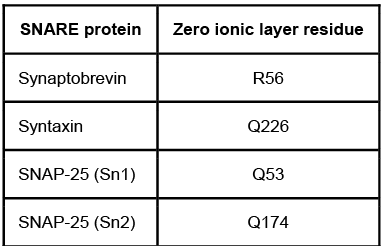
 Figure 1 Formation of the core-trans-complex and subsequent membrane fusionThe cis-complex contains the zero ionic layer, the main site of interaction between complexed proteins. Within the zero ionic layer, arginine on synaptobrevin coordinates with carbonyl groups present on the other residues shown in Table 1. The zero ionic layer is buried within leucine zipper domains, which act as a shield to solvent molecules.Table 1 Composition of cis-Complex Zero Ionic Layer
 An early step in cis-complex disassembly is destabilization by the ATPase N-ethylmaleimide-sensitive factor (NSF) , which initiates unzipping by breaking flanking leucine zipper regions, leading to vesicle reuptake. Movement of NSF to the cell membrane is mediated by the cytoplasmic protein α-SNAP, which must first bind the N-terminal domain of syntaxin.To determine the effect of vesicle-bound synaptobrevin on the binding of α-SNAP to syntaxin, increasing amounts of recombinant His-tagged α-SNAP were added to a constant amount of syntaxin affixed to glutathione-agarose beads with or without synaptobrevin. After incubation, bound proteins were recovered and quantitatively analyzed by immunoblotting. Results are shown in Figure 2.
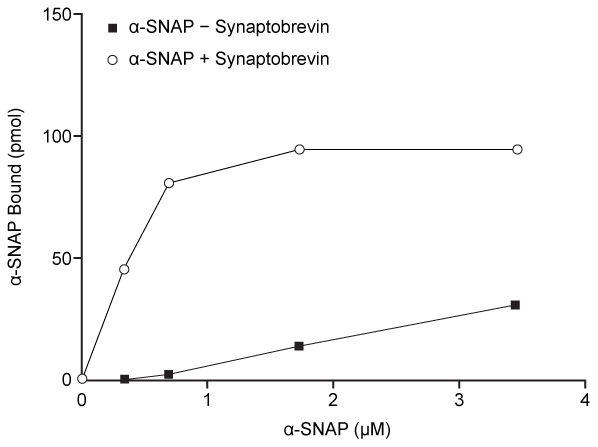 Figure 2 α-SNAP binding to syntaxin in the absence (square) or presence (circle) of synaptobrevin
Adapted from Mcmahon HT, Südhof TC. Synaptic core complex of synaptobrevin, syntaxin, and SNAP25 forms high affinity alpha-SNAP binding site. J Biol Chem. 1995;270(5) :2213-7.
-Which amino acid is LEAST likely to be found in normally functioning binding domains of t-SNARE and v-SNARE proteins?
A) Asparagine
B) Tryptophan
C) Threonine
D) Proline
Correct Answer:

Verified
Correct Answer:
Verified
Q129: Passage<br>Myalgic encephalopathy (ME), or chronic fatigue syndrome
Q130: An enzyme generates a Lineweaver-Burk plot with
Q131: Passage<br>The recent advent of multidrug-resistant Mycobacterium tuberculosis
Q132: Fatty acid oxidation and synthesis occur in
Q133: Under physiological conditions, peptide bond formation and
Q135: Passage<br>NDPK is an enzyme in budding yeast
Q136: Passage<br>Aldehyde dehydrogenase 2 (ALDH2) is essential for
Q137: Passage<br>The innate immune system relies heavily on
Q138: Passage<br>The HIV-derived transactivator of transcription (Tat) is
Q139: Passage<br>The liver plays a central role in