Multiple Choice
Passage
The bacterium Clostridium difficile secretes protein toxins TcdA and TcdB, two homologues associated with C. difficile-related colitis. Tcd proteins enter host intestinal cells via endocytosis induced by interactions between the Tcd C-terminal domain and cell surface receptors. Endocytosis is followed by translocation of the N-terminal glucosyltransferase domain (GTD) across the endosomal membrane. The GTD remains anchored to endosomes by the central region of the protein, a transmembrane domain believed to form membrane pores and facilitate translocation. Inositol hexakisphosphate (IP6) binds Tcd proteins, an interaction that is stabilized by salt bridges in the binding pocket (Figure 1) .
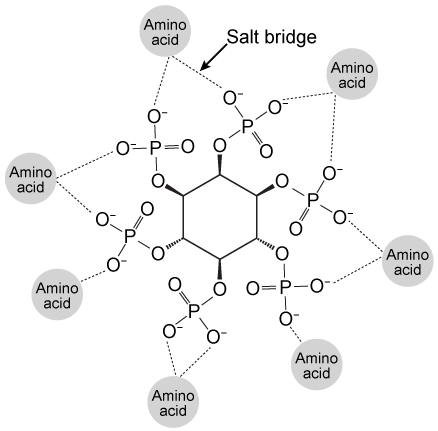 Figure 1 Salt bridges formed between IP6 and the amino acids in the binding pocketThis interaction induces a conformational change that causes a molecular flap to move away from the catalytic site. The catalytic site then mediates intramolecular cleavage in a reaction known as autoprocessing. This reaction results in the release of GTD into the cytosol, where it becomes active.To better understand the relationship between IP6 binding and catalytic activity, autoprocessing assays were performed. Researchers mutated histidine to alanine at positions 759 and 757 in the flap regions of TcdA and TcdB, respectively. They then compared the autoprocessing activities of H759A and H757A mutants to those of wild-type TcdA and TcdB at varying concentrations of IP6 (Figure 2) .
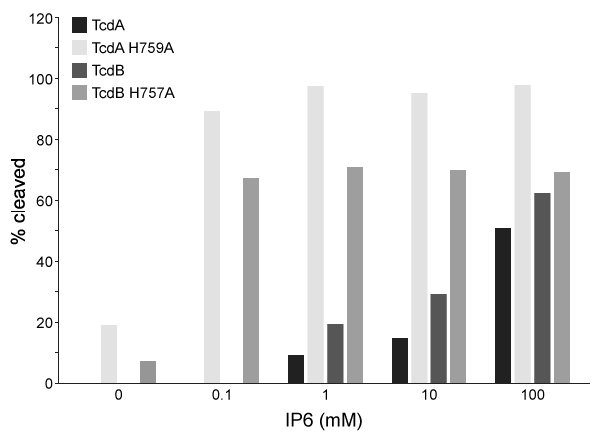 Figure 2 Percent cleavage of wild-type and mutant Tcd by autoprocessing
Adapted from Chumbler NM, Rutherford SA, Zhang Z, et al. Crystal structure of Clostridium difficile toxin A. Nat Microbiol. 2016;1:15002.
-Based on Figure 2, residues H757 and H759 of wild-type TcdA and TcdB, respectively, may function to:
A) interact with IP6, stabilizing its interaction in the binding pocket.
B) act as a general base in the IP6-dependent Tcd protease reaction mechanism.
C) mediate an interaction in the flap region necessary to obstruct the active site.
D) create charge repulsion, opposing interaction between the flap region and active site.
Correct Answer:

Verified
Correct Answer:
Verified
Q213: Passage<br>Synthesis of coenzyme A (CoA) requires vitamin
Q214: Passage<br>Mitochondria are double membrane-bound cellular organelles that
Q215: Passage<br>ATP synthase, also known as Complex V,
Q216: Passage<br>Whole grains have been shown to reduce
Q217: Which of the following steps in the
Q219: Passage<br>The sirtuins are a class of enzymes
Q220: Passage<br>The cystic fibrosis transmembrane conductance regulator (CFTR)
Q221: Researchers measured the activity of two enzymes
Q222: Which event could alter a protein's primary
Q223: Passage<br>Oxidative stress occurs in cells when reactive