Multiple Choice
Passage
In 2010, the United States (U.S.) had an incarcerated population of about 1.6 million, up from about 300,000 in 1980. Some experts suggest that the exponential rise in the inmate population has been largely due to the "war on drugs," initiated in the 1980s, which led to more aggressive laws against drug use and distribution. Increases in arrests and imprisonment, however, have not affected all segments of the U.S. population equally. Although the total population was about 50% male in 2010, the prison population was about 93% male and reflective of additional racial and ethnic disparities (Figure 1) .
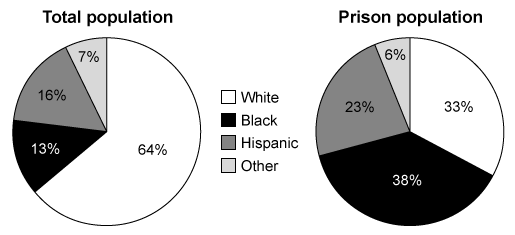 Figure 1 Total population and prison population by race and ethnicity in the United States in 2010Research suggests that black and white people use drugs at similar rates, but black people are more likely to end up in the criminal justice system for drug use. This overrepresentation of black people in the prison population can be partly explained by discrimination at the individual and institutional levels. For example, if police departments focus their resources in predominantly black neighborhoods based on the assumption that black individuals are more likely to commit a crime, then police officers (who may similarly believe black people commit more crimes than white people) are more likely to witness black people committing crimes, thereby confirming the belief. Discrimination operates at every level of the criminal justice system: Black people are more likely than white people to be arrested, prosecuted, and convicted for drug use and receive, on average, longer sentences.High rates of recidivism also perpetuate the demographic disparity of the prison population. It is estimated that about 75% of released prisoners will be rearrested within five years. Experts suggest that, once convicted of a felony, individuals find that their status as a former felon (or "ex-convict") dominates all their other statuses, making it difficult to reintegrate into society. The social stigma of criminality makes it hard for ex-convicts to secure employment, which often leads to further crime. Ex-convicts are also more closely monitored by police and far more likely to be arrested and convicted for minor offenses.
-As described in the second paragraph, disparities in prison demographics may be explained by all of the following, EXCEPT:
A) prejudice.
B) stereotype boost.
C) discrimination.
D) confirmation bias.
Correct Answer:

Verified
Correct Answer:
Verified
Q84: Passage<br>For decades psychologists have known that people
Q85: Passage<br>Human emotions play an important role in
Q86: Passage<br>Physical modifications important for consolidating memory are
Q87: Passage<br>Religion establishes the beliefs and rituals surrounding
Q88: Researchers have identified a set of factors
Q90: Passage<br>Prominent theories of emotion have long held
Q91: Passage<br>The diagnosis of a child with a
Q92: Passage<br>Researchers conducted a pair of studies to
Q93: Passage<br>Bipolar disorder (BD), often characterized by periods
Q94: Passage<br>Until the middle of the twentieth century,