Multiple Choice
Passage
Korsakoff syndrome (KS) is caused by a thiamin (vitamin B1) deficiency that often results from chronic alcohol consumption. If KS is diagnosed during its earliest stages, its course may be reversed with thiamin supplements; otherwise, it progresses into a permanent type of dementia that includes severe cognitive dysfunction and memory loss. Alzheimer disease (AD) is associated with a different type of dementia that worsens over time, eventually causing memory loss, cognitive dysfunction, and severe brain atrophy.In one study, KS and AD subjects were assessed using the Corsi block-tapping task, which measures nonverbal memory. The experiment consisted of 10 KS subjects, 10 AD subjects, and 10 healthy control subjects. The control group was matched by age, gender, and premorbid IQ (intelligence quotient preceding the occurrence of symptoms) to the KS and AD groups.
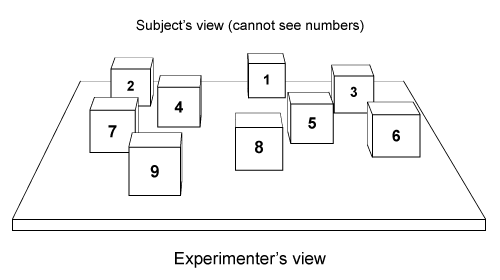 Figure 1 Corsi block-tapping taskThe Corsi block-tapping task consists of nine wooden blocks placed randomly on a board (Figure 1) . To assess subjects' nonverbal memory, the experimenter touched four numbered blocks (numbers were visible only to the experimenter) in a specific pattern. Each subject was then asked to touch the same four blocks in the same sequence, either immediately or after a delay of 5-25 seconds. Subjects were required to perform a distractor task during the delay period. For the distractor task, subjects were asked to watch and reproduce a finger-tapping sequence first demonstrated by the experimenter. Experimenters would touch a finger on their right hand to a finger on their left hand according to a specific sequence (eg, index finger to ring finger, then pinky finger to middle finger) and the subjects would try to do the same.Results indicated that compared to controls, subjects with AD and KS were significantly impaired on the delayed memory task, although all subjects showed a significantly greater number of errors with increases in the delay interval.
-The distractor and Corsi block-tapping tasks are designed to assess which of the following?
A) Proactive interference and sensory memory recall
B) Proactive interference and decay in episodic memory
C) Retroactive interference and short-term memory recall
D) Retroactive interference and decay in semantic memory
Correct Answer:

Verified
Correct Answer:
Verified
Q107: Passage<br>Post-traumatic stress disorder (PTSD) and generalized anxiety
Q108: Passage<br>Major depression is a mood disorder that
Q109: Passage<br>Text messaging while driving increases the risk
Q110: Passage<br>Major depression is a mood disorder that
Q111: Passage<br>Text messaging while driving increases the risk
Q113: Passage<br>Until recently, deviance has generally been conceptualized
Q114: Passage<br>People tend to believe that they are
Q115: Passage<br>The diagnosis of a child with a
Q116: Passage<br>In 2010, the United States (U.S.) had
Q117: Passage<br>Trait theorists believe that all people have