Multiple Choice
Passage
Researchers conducted a pair of studies to explore how rewards influence motivation and weight loss for those who are overweight or obese.For Study 1, 20 overweight and 20 average-weight adults were invited to play a computer game consisting of a simple matching task in which participants earned a reward for getting multiple correct responses. Participants were allowed to select their own reward: Either $1.00 or a 200-calorie vending machine snack (valued at $1.00) , such as a candy bar or bag of chips. For the first trial, participants were rewarded on an average of three correct responses (AVG3) . Participants were then asked to choose between the food and monetary rewards. When a food reward was selected, the average number of correct responses required to earn the next reward doubled, but when a monetary reward was selected, the average number of correct responses required to earn the next reward remained the same (Figure 1) . Results indicated that although there was no significant difference between the groups with regard to baseline self-reporting of hunger prior to the start of the computer tasks, overweight participants were five times more likely to choose the food rewards than average-weight participants.
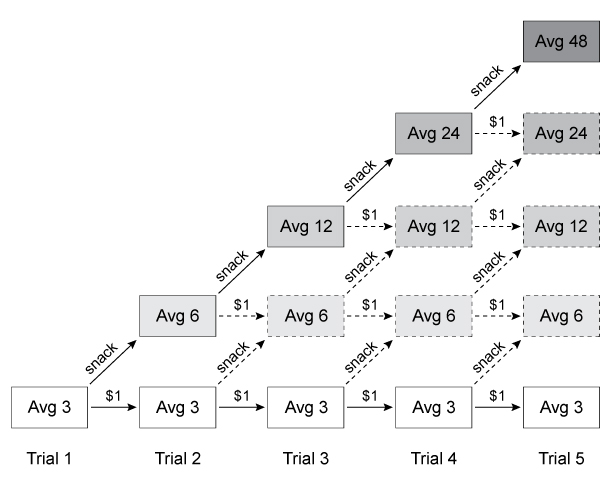 Figure 1 Study 1 reward scheduleFor Study 2, obese participants were recruited for a 16-week weight-loss study and randomly assigned to one of two groups: A control group (n = 32) or an experimental group (n = 35) . Control participants engaged in weekly weigh-ins only. Experimental participants engaged in weekly weigh-ins but also earned or lost money (put into an account and paid at the end of the study) based on their weigh-in goal, calculated each week based on current body mass index (BMI) , age, and sex. Those who reached their weekly weight goal earned $10; for each additional pound lost, participants earned another $10, up to $50/week. Participants in the experimental group who did not meet or exceed their weekly weight goal had $20 deducted from their accounts. No significant differences were found in baseline variables for either group; however, members of the control group lost an average of 5.9 pounds, whereas members of the experimental group lost an average of 18.1 pounds.
B. E. Saelens and L. H. Epstein ©1996 Elsevier B.V.
-Suppose one of the participants in Study 1 earned several candy bars and became very ill after consuming them. This participant would most likely:
A) avoid participating in any future research studies.
B) avoid playing computer games for awhile until she feels better.
C) develop a long-lasting aversion to the specific candy bars she consumed.
D) develop a short-term aversion to the candy bars available during the study.
Correct Answer:

Verified
Correct Answer:
Verified
Q95: A researcher hypothesizes that there is a
Q96: Passage<br>Before memories have been consolidated they are
Q97: A researcher conducts a study on visual
Q98: Passage<br>Visual perception involves the organization and interpretation
Q99: Passage<br>Numerous studies suggest that physicians make both
Q101: Passage<br>Studies suggest that health outcomes for preventable
Q102: Passage<br>Before memories have been consolidated they are
Q103: In a two-part procedure for teaching children
Q104: Passage<br>Religion establishes the beliefs and rituals surrounding
Q105: Passage<br>People tend to believe that they are