Multiple Choice
Passage
Researchers conducted a pair of studies to explore how rewards influence motivation and weight loss for those who are overweight or obese.For Study 1, 20 overweight and 20 average-weight adults were invited to play a computer game consisting of a simple matching task in which participants earned a reward for getting multiple correct responses. Participants were allowed to select their own reward: Either $1.00 or a 200-calorie vending machine snack (valued at $1.00) , such as a candy bar or bag of chips. For the first trial, participants were rewarded on an average of three correct responses (AVG3) . Participants were then asked to choose between the food and monetary rewards. When a food reward was selected, the average number of correct responses required to earn the next reward doubled, but when a monetary reward was selected, the average number of correct responses required to earn the next reward remained the same (Figure 1) . Results indicated that although there was no significant difference between the groups with regard to baseline self-reporting of hunger prior to the start of the computer tasks, overweight participants were five times more likely to choose the food rewards than average-weight participants.
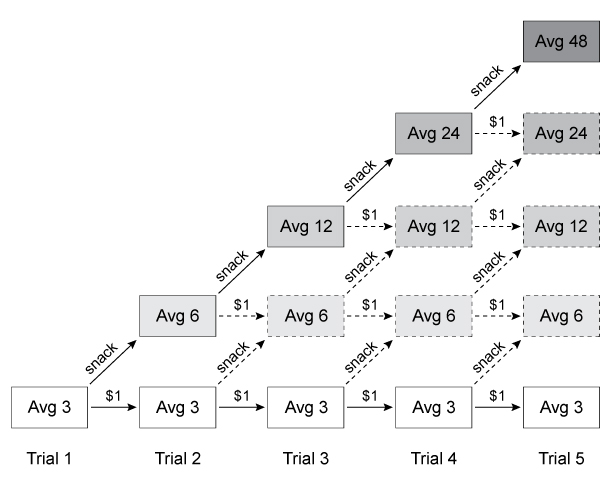 Figure 1 Study 1 reward scheduleFor Study 2, obese participants were recruited for a 16-week weight-loss study and randomly assigned to one of two groups: A control group (n = 32) or an experimental group (n = 35) . Control participants engaged in weekly weigh-ins only. Experimental participants engaged in weekly weigh-ins but also earned or lost money (put into an account and paid at the end of the study) based on their weigh-in goal, calculated each week based on current body mass index (BMI) , age, and sex. Those who reached their weekly weight goal earned $10; for each additional pound lost, participants earned another $10, up to $50/week. Participants in the experimental group who did not meet or exceed their weekly weight goal had $20 deducted from their accounts. No significant differences were found in baseline variables for either group; however, members of the control group lost an average of 5.9 pounds, whereas members of the experimental group lost an average of 18.1 pounds.
B. E. Saelens and L. H. Epstein ©1996 Elsevier B.V.
-Which of the following behavioral patterns is most expected of participants in the Study 2 experimental group? Participants are most diligent with dieting and exercise:
A) just after earning money.
B) just after losing money.
C) just before weekly weigh-ins.
D) consistently throughout the week.
Correct Answer:

Verified
Correct Answer:
Verified
Q220: Passage<br>Korsakoff syndrome (KS) is caused by a
Q221: Passage<br>Bipolar disorder (BD), often characterized by periods
Q222: Passage<br>The diagnosis of a child with a
Q223: Passage<br>Human emotions play an important role in
Q224: In an experiment, researchers find that certain
Q226: Passage<br>Post-traumatic stress disorder (PTSD) and generalized anxiety
Q227: Passage<br>Twenty-two adults (mean age 49.5) were recruited
Q228: Passage<br>Bipolar disorder (BD), often characterized by periods
Q229: Passage<br>In 2010, the United States (U.S.) had
Q230: Which of the following scenarios best illustrates