Passage Visual Perception Involves the Organization and Interpretation of Information Obtained
Multiple Choice
Passage
Visual perception involves the organization and interpretation of information obtained from visible light. Visual perception relies on monocular and binocular cues, as well as perceptual organization principles that allow humans to interpret limited or partial information more holistically. These sorts of mental shortcuts are based on prior experiences and knowledge, and are especially useful when lighting or perspective is limited. For example, the ambiguous image in Figure 1 is often perceived as a cup.
 Figure 1 Ambiguous imagePerceptual organization principles allow our brains to quickly and efficiently make assumptions about visual inputs, but these principles can also give rise to perceptual illusions. For example, the Ames room is constructed to exploit monocular depth cues in such a way that the person standing on one side of the room appears to impossibly dwarf the person on the other side of the room (Figure 2) .
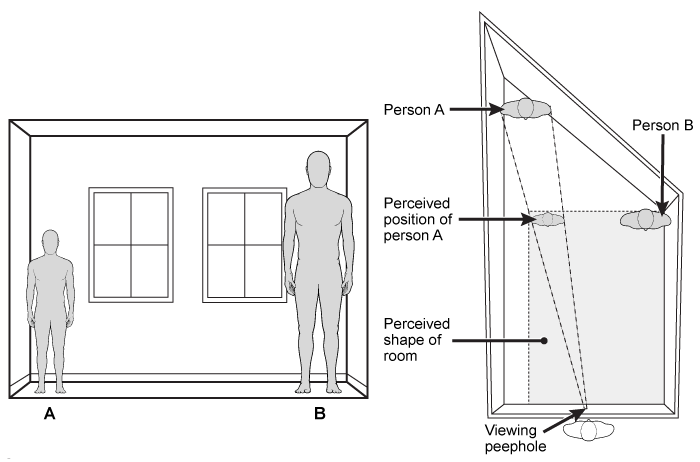 Figure 2 Ames room illusion (two people standing in a specially constructed Ames room, viewed through a monocular peephole) Human senses were adapted for use on land, which can lead to potentially deadly perceptual distortions while flying or underwater diving. Pilots are prone to such perceptual distortions when landing on unfamiliar runways. During their training, pilots develop a mental image of how a typical runway appears as they descend and land. Later, they compare this prototypical shape to the runway they see before them to make adjustments in the slope of their descent. However, if a runway differs from what the pilot is used to (eg, in width or slope) , it will differ from the pilot's mental image for a typical runway at that same altitude. For example, an unusually wide runway will appear to be closer than it actually is, and a narrow runway will seem to be further away. This can cause the pilot to approach at a dangerously steep or shallow slope.Pilots and divers can also suffer from spatial disorientation due to variations in sensory stimuli that are not typically encountered on land. For example, gravity is not experienced in the body the same way underwater as on land, and visual cues are often limited in deep dives. In these murky conditions, divers can easily lose track of the surface of the water, leading to extreme spatial disorientation and panic.
-Pilots who experienced perceptual distortions while landing on an unusually wide runway were most likely affected by which type of monocular depth cue?
A) Interposition
B) Linear perspective
C) Light and shadow
D) Texture gradient
Correct Answer:

Verified
Correct Answer:
Verified
Q13: Passage<br>Korsakoff syndrome (KS) is caused by a
Q14: Passage<br>Patients undergoing chemotherapy frequently experience a number
Q15: Passage<br>Visual perception involves the organization and interpretation
Q16: Passage<br>Religion establishes the beliefs and rituals surrounding
Q17: Passage<br>Language is a skill acquired during early
Q19: Passage<br>Although the terms sex, sex category, and
Q20: When first memorizing neuroanatomical structures and their
Q21: Passage<br>Physical modifications important for consolidating memory are
Q22: Passage<br>The last several decades have seen a
Q23: Passage<br>Before memories have been consolidated they are