Multiple Choice
Passage
The highly addictive nature of cigarettes can be partly explained by how nicotine, the primary addictive ingredient, is administered. The fastest route of administration for most drugs is through inhalation; cigarette smoking results in the transmission of nicotine to the brain in about 15 seconds. In the brain, nicotine activates the nicotinic acetylcholine receptors, which stimulate the brain's reward pathway and produce mild feelings of euphoria. Those who quit smoking often relapse due to stress, weight gain, and withdrawal symptoms such as cravings and irritability. Of those who attempt to quit without formal treatment, only 3%-5% remain abstinent after a year.Research suggests that mindfulness meditation-based programs can be an effective strategy to quit smoking. Mindfulness is an aspect of meditation that involves cultivating a nonjudgmental awareness of the thoughts, emotions, and sensations arising in the present moment.For one study, researchers randomly assigned 88 smokers to either Mindfulness Training (MT) or the Freedom From Smoking (FFS) intervention developed by the American Lung Association. Both groups participated in 90-minute group training sessions twice a week for four weeks. The FFS intervention educated participants on the negative health consequences of smoking, coping strategies for cravings, and the development of healthy lifestyle habits. The MT intervention taught mindfulness meditation techniques as a way of gaining awareness and acceptance of the cognitive, emotional, and physical components of cravings. The number of cigarettes smoked per day and self-reported abstinence, as verified by exhaled carbon monoxide, were measured at the end of treatment and at a 17-week follow-up for participants in each group (Figure 1) .
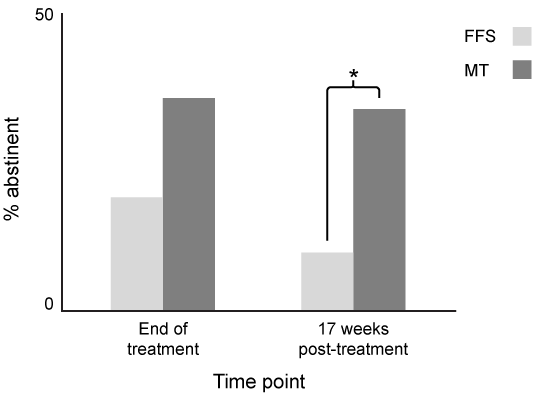 Figure 1 Percentage of participants in each group abstinent at the end of treatment and at 17-week follow-up (* indicates p < 0.05)
-Which of the following conclusions is supported by these data reflecting the relationship between cigarette craving and smoking behavior before and after MT intervention? 
A) Before beginning MT intervention, high levels of craving caused an increase in smoking behavior.
B) A significant difference in smoking behavior was observed before and after MT intervention.
C) A significant difference in cigarette craving was observed before and after MT intervention.
D) The relationship between craving and smoking was weaker after the MT intervention.
Correct Answer:

Verified
Correct Answer:
Verified
Q127: A patient who has been diagnosed with
Q128: Passage<br>Research suggests that cognitive changes occur with
Q129: Passage<br>Patients undergoing chemotherapy frequently experience a number
Q130: Passage<br>Until recently, deviance has generally been conceptualized
Q131: An individual is distressed by her attraction
Q133: Passage<br>Jake and his classmate Michael both grew
Q134: Passage<br>The term "health disparities" describes a systematic
Q135: Passage<br>Patients undergoing chemotherapy frequently experience a number
Q136: Passage<br>Religion establishes the beliefs and rituals surrounding
Q137: Passage<br>During the 1800s, the United States (U.S.)