Multiple Choice
Passage
Lucid dreaming occurs when a person becomes consciously aware of a dream and uses executive decision-making skills to critically analyze the dream environment. Lucid dreamers are thus able to control certain aspects of their dreams, an ability that may occur intentionally, through practice, or unintentionally, usually after having noticed something bizarre or unrealistic in the dream. A lucid dreamer might choose to experience the sensation of flying, explore a custom-designed landscape, carry out a predetermined task, or practice a skill. Estimates suggest that about half the population has had a lucid dream, and about 10%-20% of people are considered frequent lucid dreamers experiencing such dreams regularly (at least once a month) .In one study, researchers asked participants to perform a difficult visuomotor task that involved throwing an object through a small moving target. Participants were organized into three groups, one group of frequent lucid dreamers and two groups of nonlucid dreamers. All three groups attempted the visuomotor task at midday in the research lab, before (pretest) and after (posttest) a single night's sleep at home. Lucid dreamers were asked to only practice the visuomotor task overnight during their lucid dream ("lucid practice" group) . One group of nonlucid dreamers practiced the task in the lab, right after the pretest ("waking practice" group) , and another group of nonlucid dreamers performed the pretest and posttest without practicing between the tests ("no practice" group) . The average improvement of hits (the number of times each participant successfully threw the object through the target) from pretest to posttest for each group is shown in Figure 1.
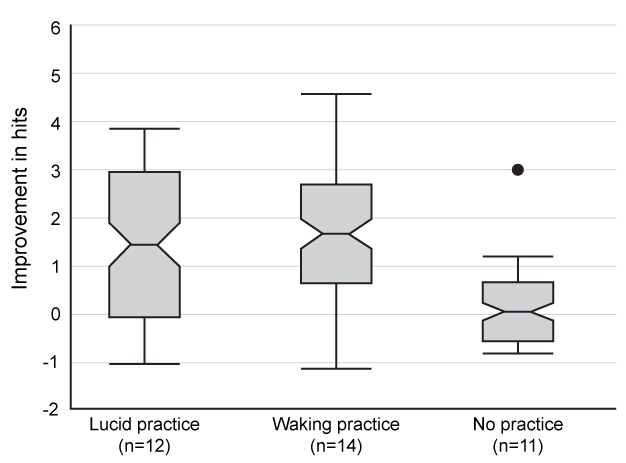 Figure 1 Median improvement in total hits for each group (Note: The notches represent the 95% confidence interval for the median.) The researchers proposed that a follow-up study be devised and conducted to control for any potential variability in each participant's sleep at home. The researchers suggested using the same study procedure except participants would sleep overnight for five consecutive nights in a sleep lab, where the timing and duration of sleep would be standardized. In order to eliminate any potential "first-night effects" (an initial reduction in sleep quality when sleeping in an unfamiliar environment) , researchers proposed that pretest and posttest measures each be taken before and after the third, fourth, and fifth night's sleep.
-Which of the following conclusions is most supported by Figure 1?
A) An individual from the "lucid practice" group demonstrated the lowest improvement of all members.
B) The difference in task improvement between the "lucid practice" group and the "no practice" group was statistically significant.
C) The "lucid practice" group's lowest quartile improved more on the task than the "no practice" group's highest quartile.
D) The mean score for the "waking practice" group was higher than the mode scores for the other two groups.
Correct Answer:

Verified
Correct Answer:
Verified
Q295: Passage<br>The term "health disparities" describes a systematic
Q296: Passage<br>The diagnosis of a child with a
Q297: Passage<br>Prominent theories of emotion have long held
Q298: The interactionist theory of language development suggests
Q299: Passage<br>A common misconception in medicine is that
Q301: Passage<br>Psychophysiology examines the relationship between the properties
Q302: Passage<br>Studies suggest that health outcomes for preventable
Q303: Passage<br>Both institutional and interpersonal factors contribute to
Q304: Passage<br>Health psychologists interested in studying the influence
Q305: Passage<br>Research suggests that individuals with depression experience