Multiple Choice
Examine the network exhibit. 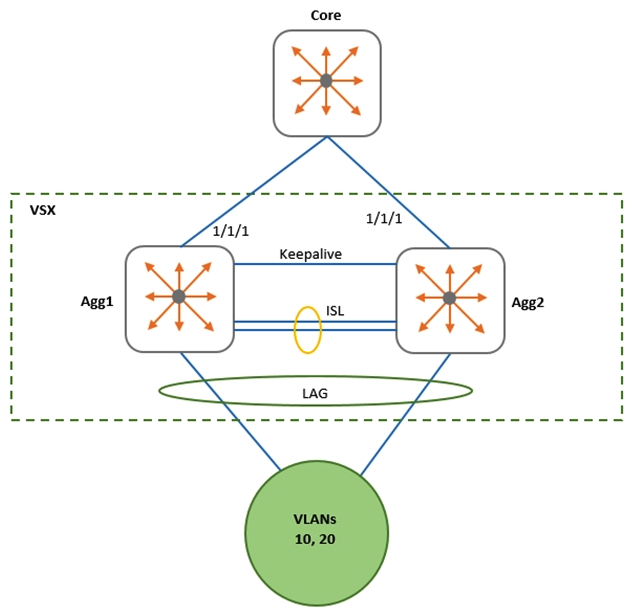 A network administrator is implementing OSPF on a VSX pair of aggregation switches: Agg1 and Agg2. VLANs 10 and 20 are connected to layer-2 access switches. Agg-1 and Agg-2 are configured as the default gateway for VLANs 10 and 20, with active gateway enabled. What is the best practice for configuring OSPF on the aggregation switches and their connection to the Core switch?
A) Define a layer-2 VSX LAG associated with a layer-3 VLAN interface. Enable active gateway for the Layer-3 VLAN.
B) Define separate layer-3 VLAN interfaces between the aggregation and core switches. Enable active forwarding for the Layer-3 VLAN.
C) Define separate layer-3 VLAN interfaces between the aggregation and core switches. Enable active gateway for the Layer-3 VLAN.
D) Define a layer-2 VSX LAG associated with a layer-3 VLAN interface. Enable active forwarding for the Layer-3 VLAN.
Correct Answer:

Verified
Correct Answer:
Verified
Q65: An administrator is configuring BGP and has
Q66: An administrator has an aggregation layer of
Q67: Examine the attached exhibit. <img src="https://d2lvgg3v3hfg70.cloudfront.net/C1454/.jpg" alt="Examine
Q68: What is correct regarding rate limiting and
Q69: In AOS-CX switching, what determines when a
Q71: A network administrator wants to centralize the
Q72: When implementing deficit weighted round robin queuing,
Q73: An administrator is defining a VSX LAG
Q74: A network administrator is attempting to troubleshoot
Q75: An administrator wants to drop traffic from