Multiple Choice
Service A is a task service that sends Service B a message (2) requesting that Service B return data back to Service A in a response message (3) . Depending on the response received. Service A may be required to send a message to Service C (4) for which it requires no response. Before it contacts Service B, Service A must first retrieve a list of code values from its own database (1) and then place this data into its own memory. If it turns out that it must send a message to Service C, then Service A must combine the data it receives from Service B with the data from the code value list in order to create the message it sends to Service C. If Service A is not required to invoke Service C, it can complete its task by discarding the code values. Service A and Service C reside in Service Inventory A. Service B resides in Service Inventory B. 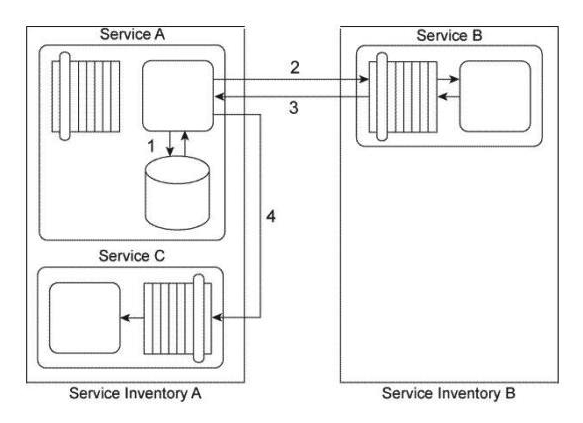 You are told that the services in Service Inventory A are all SOAP-based Web services designed to exchange SOAP 1.1 messages and the services in Service Inventory B are SOAP-based Web services designed to exchange SOAP 1.2 messages. Therefore, Service A and Service B cannot currently communicate. Furthermore, you are told that Service B needs to access a shared database in order to retrieve the data required by Service A. The response time of the database can sometimes be lengthy, which would cause Service A to consume too much resources while it is waiting and keeping the code values in memory. How can this service composition architecture be changed to avoid these problems?
A) The Protocol Bridging pattern can be applied by establishing an intermediate processing layer between Service A and Service B that can convert SOAP 1.1 messages to SOAP 1.2 messages and vice versa. The Service Data Replication pattern can be applied to Service B so that it is given a dedicated database with its own copy of the data it needs to access. The Service Normalization pattern can then be applied to ensure that the data within the replicated database is normalized with the shared database it is receiving replicated data from.
B) The Protocol Bridging pattern can be applied by establishing an intermediate processing layer between Service A and Service B that can convert SOAP 1.1 messages to SOAP 1.2 messages and vice versa. The Service Statelessness principle can be applied with the help of the State Repository pattern so that Service A can write the code value data to a state database while it is waiting for Service B to respond.
C) The Protocol Bridging pattern can be applied by establishing an intermediate processing layer between Service A and Service B that can convert SOAP 1.1 messages to SOAP 1.2 messages and vice versa. The Intermediate Routing pattern can be applied to dynamically determine whether Service A should send a message to Service C. The Service Autonomy principle can be applied to Service A to further increase its behavioral predictability by reducing the amount of memory it is required to consume.
D) None of the above.
Correct Answer:

Verified
Correct Answer:
Verified
Q2: Service A has become increasingly difficult to
Q3: Service A is a utility service that
Q4: Our service inventory contains the following three
Q5: Service Consumer A sends a message to
Q6: Service A is an entity service that
Q8: When Service A receives a message from
Q9: Service A is a utility service that
Q10: Service Consumer A sends Service A a
Q11: Service A is a task service that
Q12: Service A is an entity service that