Multiple Choice
A 26-year-old man comes to the office after learning that one of his sexual partners tested positive for HIV. The patient has had intermittent headaches, malaise, nausea, and blurry vision over the last several weeks. He has had no fever, sore throat, skin rash, genital lesions, or weight loss. The patient has no prior history of sexually transmitted infections or chronic medical problems. He smokes a pack of cigarettes daily, consumes alcohol occasionally, and does not use illicit drugs. The patient has had multiple sexual partners over the last several years and does not use condoms consistently. Temperature is 37.1 C (98.8 F) , blood pressure is 122/74 mm Hg, and pulse is 72/min. There is no scleral icterus, oropharyngeal lesions, or skin rash. Mild, generalized lymphadenopathy is present. Cardiopulmonary and abdominal examinations are normal. Cranial nerves, deep tendon reflexes, and sensation are normal. No nuchal rigidity is present. Ophthalmologic examination reveals no abnormalities. Screening HIV immunoassay is positive. Other laboratory studies are as follows: 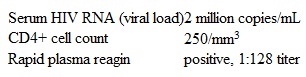 A subsequent fluorescent treponemal antibody absorption test is positive. Contrast-enhanced CT scan of the head reveals no space-occupying lesions. Several hours after the appropriate treatment for the syphilis is administered, the patient develops a fever and headache and feels "achy all over." On repeat evaluation, temperature is 38.1 C (100.6 F) , blood pressure is 130/82 mm Hg, and pulse is 105/min. The remainder of the physical examination is unchanged. Which of the following could have prevented this patient's current condition?
A) Assessment of drug interactions
B) Careful history-taking of allergies
C) No effective prevention is available
D) Pretreatment with antihistamines
E) Pretreatment with corticosteroids
Correct Answer:

Verified
Correct Answer:
Verified
Q306: A 22-year-old man comes to the office
Q388: A 63-year-old man comes to the office
Q390: A 72-year-old man is brought to the
Q391: A 63-year-old woman comes to the office
Q392: A 48-year-old woman comes to the office
Q394: A 58-year-old woman comes to the office
Q395: A 46-year-old woman comes to the office
Q396: A 3-day-old boy is brought to the
Q397: A 23-year-old man is hospitalized for acute
Q398: A 25-year-old woman, gravida 1 para 0