Multiple Choice
A study was conducted to identify factors associated with rebleeding in patients admitted to the hospital with upper gastrointestinal hemorrhage. The medical charts of 2,488 patients were analyzed retrospectively, and a logistic regression analysis was conducted to identify potential risk factors for rebleeding. An excerpt of study results is shown below. 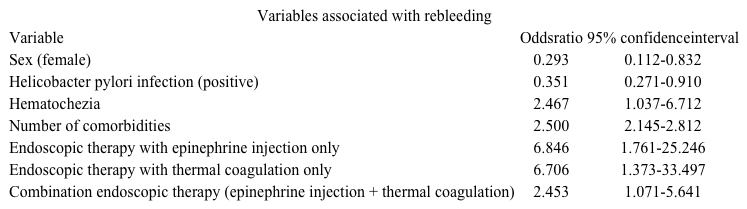 No missing data points regarding the type of endoscopic therapy received, comorbidities, or Heliobacter pylori status were reported in the study. Which of the following is the best interpretation of the study results?
A) Endoscopic therapy with epinephrine injection increases the odds of controlling rebleeding
B) The average number of comorbidities in the group of patients who rebleed is 2.5
C) The odds of hematochezia are significantly higher among female patients than among male patients
D) The odds of rebleeding are about 65% lower among patients who are H pylori-positive compared to patients who are H pylori-negative
E) The odds ratio for rebleeding among patients who undergo combination endoscopic therapy represents strong evidence of causation
Correct Answer:

Verified
Correct Answer:
Verified
Q1042: A 32-year-old man is evaluated for syncope.
Q1043: A 13-year-old boy is brought to the
Q1044: A 15-year-old boy comes to the office
Q1045: A 48-year-old woman comes to the office
Q1046: An 18-year-old woman comes to the office
Q1048: A 34-year-old man is brought to the
Q1049: A 32-year-old woman comes to the physician
Q1050: A 56-year-old man comes to the physician
Q1051: A 29-year-old Asian woman, gravida 1 para
Q1052: A 17-year-old girl is brought to an