Multiple Choice
A 66-year-old man comes to the office due to several weeks of severe constipation and increasing back pain. The patient notes that he has always had regular bowel movements; however, for the last 2 months, he has required over-the-counter laxatives to produce any stool. During this period, he has also had increasing pain in his lower back. He has had no trauma to that area. There is no radiation down the legs, bowel incontinence, or lower extremity weakness. The patient takes lisinopril for hypertension and ibuprofen as needed for back pain. He does not use tobacco or alcohol. Temperature is 36.1 C (97 F) , blood pressure is 134/80 mm Hg, and pulse is 78/min. Mucosal pallor is present. He is anicteric. Cardiopulmonary and abdominal examinations are normal. Rectal examination reveals a smooth, nonenlarged prostate. The stool is negative for occult blood. Strength and reflexes are intact in his lower extremities. Laboratory results are as follows: 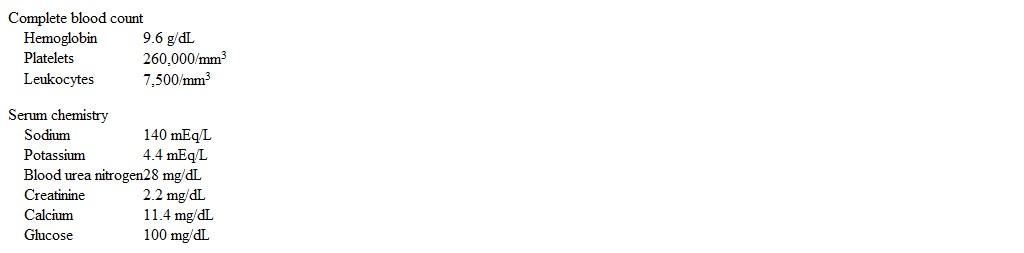 Which of the following is the best explanation for this patient's constipation?
A) Electrolyte disturbance
B) Hormonal disturbances
C) Irritable bowel syndrome
D) Mechanical obstruction
E) Medication side effect
F) Neurologic dysfunction
Correct Answer:

Verified
Correct Answer:
Verified
Q748: A 64-year-old man comes to the emergency
Q749: A 26-year-old woman is brought to the
Q750: A 34-year-old man comes to the office
Q751: A 68-year-old man comes to the clinic
Q752: A 55-year-old male presents with face and
Q754: A 55-year-old man is hospitalized after a
Q755: A 75-year-old man is being evaluated for
Q756: A 47-year-old man is evaluated for progressively
Q757: An 18-year-old man seeks advice before going
Q758: A 56-year-old woman comes to the office