Multiple Choice
A 22-year-old African American man is evaluated for gross hematuria. He has had 5 days of grossly bloody urine every time he urinates. He denies associated flank or abdominal pain, back or abdominal trauma, fever, chills, or dysuria. There is no family history of either a bleeding disorder or kidney disease. He had a similar episode one year ago which lasted 5-10 days and resolved spontaneously. During that time, he had an unremarkable ultrasound of his kidneys. He has had no recent illnesses and he takes no medications. He had an uncomplicated knee surgery two years ago for a torn ligament. He had two girlfriends over the last year, and he used condoms occasionally.
He is very muscular with a BMI of 25 kg/m2. His blood pressure is 133/82 mm Hg and pulse is 89 /min. He has no costovertebral angle tenderness. Abdominal exam is unremarkable. Laboratory results are as follows: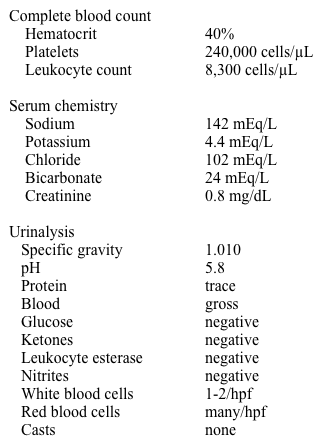
Which of the following is most likely to confirm this patient's diagnosis?
A) Autoantibodies and complement level
B) Coagulation studies
C) Cystoscopy
D) Hemoglobin electrophoresis
E) Renal biopsy
Correct Answer:

Verified
Correct Answer:
Verified
Q134: A 64-year-old man comes to the physician
Q135: A 48-year-old woman comes to the physician
Q136: A 20-year-old man comes to the physician
Q137: A 68-year-old man comes to the office
Q138: An 18-year-old previously healthy woman comes to
Q140: A 40-year-old woman comes to the office
Q141: An 18-year-old woman comes to the office
Q142: A 51-year-old man comes to the physician
Q143: A 22-year-old woman comes to the office
Q144: An 80-year-old man admitted to the hospital