Multiple Choice
A 72-year-old man comes to the office accompanied by his daughter. She relates that he is not doing well and frequently does not answer his phone until noon. There was little food in the refrigerator when she visited recently. The patient appears to care less about his grooming and appearance lately and does not seem to be eating well. His wife died 2 years ago. After a period of mild depression immediately following her death, he felt better and has continued to live independently.
The patient says that he is doing fine. He admits to insomnia (frequent awakenings in the middle of the night) and not eating well. He spends his days playing cards with friends and watching televised sports and news programs. He has been to the emergency department twice in the last 8 months, once to be checked after a minor motor vehicle accident and once after suffering a shoulder injury in a fall. The patient appears to be his stated age on general examination. Blood pressure is 148/90 mm Hg and pulse is 84/min. BMI is 18 kg/m2. His general examination is unremarkable. The patient scores 27/30 on the Mini-Mental State Examination. He has no suicidal ideation. There are no focal neurologic findings.
Laboratory results are as follows: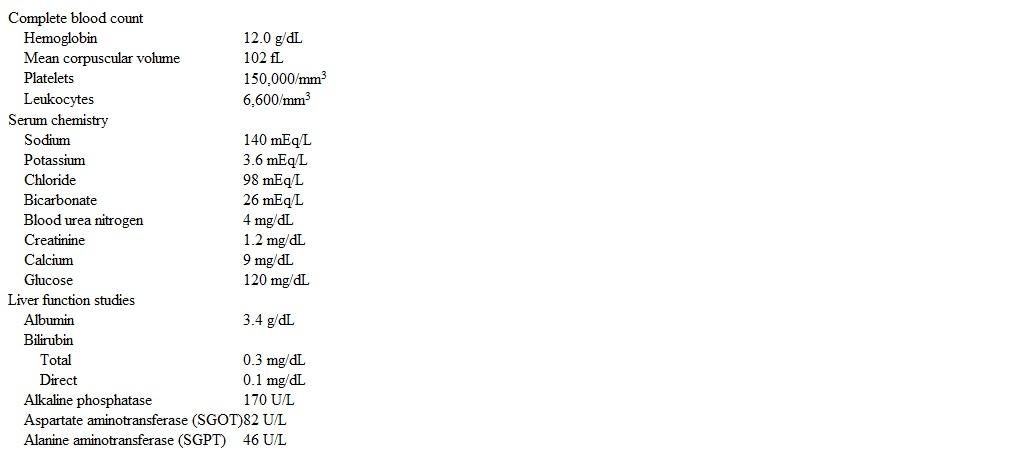 Which of the following is the most likely primary cause of the patient's decline?
A) Cognitive impairment
B) Major depressive disorder
C) Occult malignancy
D) Poor nutritional status
E) Substance use disorder
Correct Answer:

Verified
Correct Answer:
Verified
Q177: A 77-year-old woman is transferred to a
Q178: A 48-year-old man comes to the office
Q179: A 20-year-old woman comes to the physician
Q180: A 57-year-old woman comes to the office
Q181: A 36-year-old woman comes to the physician
Q183: A 67-year-old woman comes to the physician
Q184: A 48-year-old woman comes to the clinic
Q185: A 52-year-old man comes to the office
Q186: A 41-year-old woman comes to the office
Q187: A 65-year-old woman with a history of