Multiple Choice
A 64-year-old man comes to the office for routine follow-up. He has a history of chronic obstructive pulmonary disease and notes mild dyspnea when walking long distances or ascending several flights of stairs, which is unchanged from his previous visits. Six months ago, the patient was diagnosed with testosterone deficiency after work-up for fatigue and decreased libido revealed low serum testosterone levels. He was initiated on injectable testosterone replacement therapy and notes a significant improvement in his symptoms. Other medical problems include hypertension and gastroesophageal reflux. The patient is an ex-smoker with a 20-pack-year history.
Blood pressure is 126/78 mm Hg and pulse is 72/min. Oxygen saturation while breathing ambient air is 96% at rest and 90% after several minutes of walking. Breath sounds are distant with no wheezing. Heart sounds are normal. The abdomen is soft and nontender. Prostate size is normal.
Laboratory results are as follows: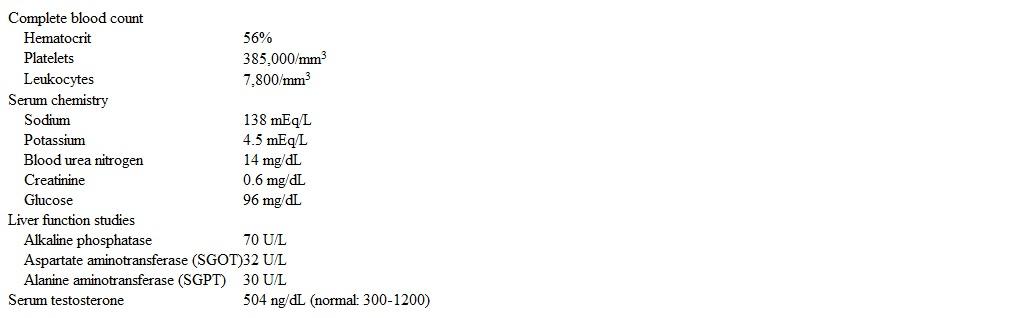 Which of the following is the most appropriate next step in management of this patient?
A) Begin long-term oxygen therapy
B) Decrease testosterone dosage
C) Measure serum erythropoietin level
D) Obtain JAK2 V617F mutation analysis
E) Perform overnight oxygen saturation study
Correct Answer:

Verified
Correct Answer:
Verified
Q210: An 18-year-old woman comes to the physician
Q211: A 53-year-old woman comes to the hospital
Q212: A 28-year-old woman comes to the office
Q213: A 30-year-old woman comes to the physician
Q214: A 75-year-old man is admitted to the
Q216: A 55-year-old-man comes to the office due
Q217: A 50-year-old woman comes to the office
Q218: A 39-year-old man comes to the clinic
Q219: A 71-year-old man comes to the physician
Q220: A 21-year-old woman is referred for evaluation