Multiple Choice
A 52-year-old man comes to the physician with generalized weakness and abdominal distention. He has had these symptoms for the past 5 months and says that his abdominal girth has gradually increased. He has no other complaints. His other medical problems include hepatitis C-induced cirrhosis and depression. The patient has a 24-pack-year history of cigarette smoking and drinks vodka daily. He admits to using intravenous drugs in the past.
His vital signs are within normal limits, but he has gained 6.8 kg (15 lb) since his last visit 6 months ago. Examination reveals a distended and nontender abdomen with fluid wave and shifting dullness. There is no rebound tenderness or rigidity. His cardiopulmonary examination is unremarkable. Skin examination shows a few spider nevi. He has 2+ pitting pedal edema to the mid-shin bilaterally.
Laboratory results are as follows: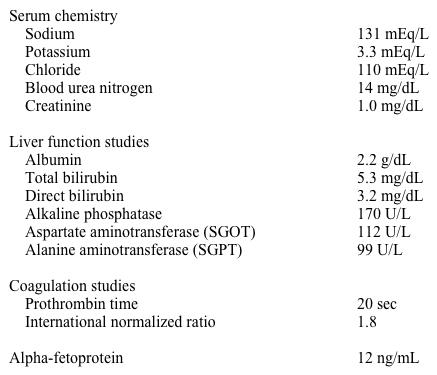
Abdominal ultrasound confirms the presence of a moderate amount of ascites, no focal liver masses, and moderate splenomegaly. A diagnostic paracentesis shows polymorphonuclear count of 88/mm3, total protein of 1.4 g/dL, and albumin of 0.9 g/dL.
Which of the following is the best next step in management of this patient?
A) High-dose furosemide and low-dose spironolactone
B) High-dose spironolactone and low-dose furosemide
C) Refer for liver transplant evaluation
D) Strict fluid restriction and angiotensin-converting enzyme inhibitor
E) Therapeutic paracentesis followed by fluid restriction
Correct Answer:

Verified
Correct Answer:
Verified
Q693: A 34-year-old forest service firefighter comes to
Q694: A 42-year-old woman comes to the office
Q695: A 54-year-old man is evaluated for worsening
Q696: A 35-year-old woman comes to the office
Q697: A 25-year-old previously healthy woman comes to
Q699: A 27-year-old woman comes to the physician
Q700: A 33-year-old primigravida at 32 weeks gestation
Q701: An 80-year-old man comes to the office
Q702: A 39-year-old man comes to the office
Q703: A 32-year-old woman comes to the office