Multiple Choice
A 57-year-old man undergoes bronchoscopy for a persistent cough productive of blood-tinged sputum. He denies chest pain, shortness of breath, wheezing, and weight loss. He is a long-term cigarette smoker. He is allergic to peanuts and shell fish. A physical examination does not reveal any significant abnormalities. He is sedated with fentanyl and midazolam, and a local anesthetic is applied. The bronchoscope is subsequently introduced into the trachea without difficulty. About 10 minutes into the procedure, he is noted to be cyanotic by the medical assistant. The procedure is aborted and supplemental oxygen is administered.
His blood pressure is 112/78 mm Hg, pulse is 115/min, and respiratory rate is 20/min. Pulse oximetry has fallen from 94% pre-procedure to 85% at present. There is central cyanosis. Vesicular breath sounds are heard bilaterally. Myoclonic jerks involving all extremities are apparent. There is no skin rash.
Immediate arterial blood gas analysis shows the following: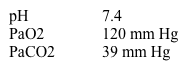
Which of the following is the most likely diagnosis?
A) Acute lung injury
B) Air embolism
C) Anaphylactoid reaction
D) Methemoglobinemia
E) Opioid (fentanyl) overdose
Correct Answer:

Verified
Correct Answer:
Verified
Q55: An 81-year-old man is transferred from a
Q56: A 78-year-old woman is admitted to the
Q57: A 68-year-old woman admitted for community-acquired pneumonia
Q58: A 31-year-old farmer is hospitalized with a
Q59: A 40-year-old woman is seen 48 hours
Q61: A 44-year-old woman is brought to the
Q62: A 25-year-old man sustained a head injury
Q63: A 29-year-old woman undergoes thyroidectomy for Graves'
Q64: A 63-year-old man with chronic obstructive pulmonary
Q65: A 63-year-old man is scheduled for coronary