Multiple Choice
An 83-year-old man with mild cognitive impairment is transported from an assisted living facility with a 2-day history of abdominal pain and decreased oral intake. He has no vomiting, fever, or urinary symptoms. He underwent coronary artery bypass grafting 6 years ago. The patient also had a stent placed in his superficial femoral artery 3 years ago for claudication due to peripheral artery disease.
His temperature is 37.3° C (99.2° F) , blood pressure is 127/77 mm Hg, and pulse is 102/min. He appears uncomfortable. Examination shows dry membranes. The abdomen is distended, diffusely tender, and tympanic to percussion. There is no rebound tenderness or rigidity.
Laboratory results are as follows: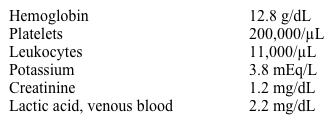
Contrast abdominal imaging, shown below, reveals a large, air-filled sigmoid colon with absence of air in the rectum.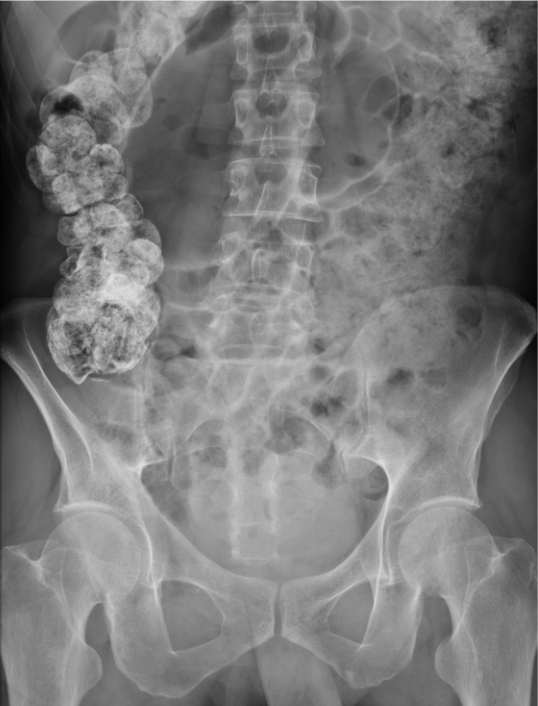
Which of the following is the best next step in managing this patient?
A) Flexible sigmoidoscopy
B) Nasogastric suction and broad-spectrum antibiotics
C) Oral lactulose
D) Sodium phosphate enema
E) Surgery
Correct Answer:

Verified
Correct Answer:
Verified
Q80: A 62-year-old man comes to the hospital
Q81: A 61-year-old man with a history of
Q82: A 32-year-old African American man is admitted
Q83: A 69-year-old man is admitted to the
Q84: A 65-year-old woman comes to the emergency
Q86: A 62-year-old woman comes to the emergency
Q87: A 55-year-old man comes to the physician
Q88: A 65-year-old woman with a history of
Q89: A 58-year-old man with a history of
Q90: A 64-year-old man hospitalized with acute myocardial