Multiple Choice
A 48-year-old man is evaluated in the surgical intensive care unit for tachycardia and hypotension. He underwent a hemicolectomy due to a perforated colonic diverticulum yesterday. The patient has a history of hyperlipidemia but no known history of heart disease. His current medications include piperacillin/tazobactam, famotidine, and benzodiazepines and opioids for sedation.
The patient is intubated and the ventilator is in the assist control mode. His temperature is 39.4 C (103 F) , blood pressure is 86/55 mm Hg, and pulse is 142/min. Oxygen saturation is 99% on 40% FiO2.
Examination shows flat neck veins and tachycardia with an irregular rhythm. Breath sounds are heard bilaterally without wheezes or rhonchi. The abdomen is soft but diffusely tender and the incision is clean. The stoma is pink without any fluid output in the bag. The patient's extremities are warm with 2+ pulses and no peripheral edema. His urine output is 10 mL/hr.
Laboratory results are as follows: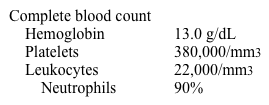
ECG shows atrial fibrillation with rapid ventricular response. There are no significant ST-segment or T wave changes.
Which of the following would be the most appropriate next step in management of this patient?
A) Electrical cardioversion
B) Intravenous (IV) digoxin
C) IV metoprolol
D) IV normal saline
E) Norepinephrine drip
Correct Answer:

Verified
Correct Answer:
Verified
Q64: A 63-year-old man with chronic obstructive pulmonary
Q65: A 63-year-old man is scheduled for coronary
Q66: A 74-year-old man recovering from recent ischemic
Q67: A 55-year-old man is evaluated for acute
Q68: A 73-year-old smoker is brought to the
Q70: A 60-year-old man is hospitalized for acute
Q71: A 60-year-old man with alcoholism is admitted
Q72: A 78-year-old man is brought to the
Q73: A 55-year-old construction worker is brought to
Q74: A 23-year-old woman with known type 1