Multiple Choice
A 64-year-old woman is evaluated for progressive gait disturbance over the last 2 years. The patient feels her feet are "stuck on the floor" and that she is unsteady while walking. She also recently began experiencing urinary urgency and has wet herself several times due to difficulty getting to the bathroom on time. The patient stopped working 6 months ago because of difficulty concentrating, and she has also lost interest in her hobbies and social activities. She has had no tremor, visual changes, headaches, nausea, or vomiting. The patient has a remote history of closed traumatic brain injury. Vital signs are within normal limits. On physical examination, lower extremity tone and deep tendon reflexes are increased. Sensation to light touch, pain, and vibration are normal. The patient's gait is slow with small steps and a wide base. CT scan of the head is shown below. 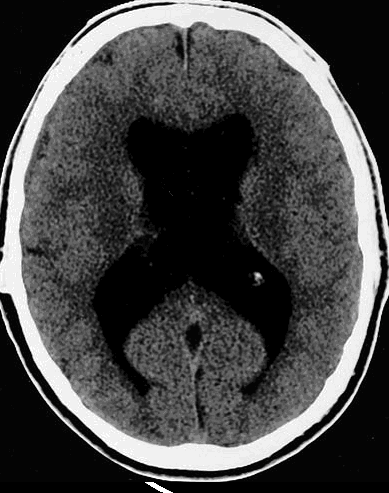 Which of the following is the most likely diagnosis?
A) Alzheimer disease
B) Frontotemporal dementia
C) Idiopathic Parkinson disease
D) Major depressive disorder
E) Normal pressure hydrocephalus
F) Obstructive hydrocephalus
G) Vitamin B12 deficiency
Correct Answer:

Verified
Correct Answer:
Verified
Q467: Further evaluation of the patient reveals microscopic
Q468: A 32-year-old man comes to the emergency
Q469: A 45-year-old man comes to the office
Q470: A 27-year-old woman comes to the emergency
Q471: A 10-year-old girl is brought to clinic
Q473: A 27-year-old woman comes to the office
Q474: A 27-year-old man comes to the emergency
Q475: A 48-year-old man who recently immigrated to
Q476: A 45-year-old woman comes to the office
Q477: A 54-year-old man is evaluated in the