Multiple Choice
A 4-year-old boy is brought to the office due to headaches that have worsened progressively over the past month and are most severe when lying down. He also has had nonbloody, nonbilious emesis for 2 weeks that typically occurs early in the morning. In addition, the child has intermittent blurry vision, particularly when looking up at the mirror while brushing his teeth. Physical examination shows bilateral papilledema, inability to gaze upwards, and bilateral eyelid retraction. Laboratory testing of sodium, growth hormone, luteinizing hormone (LH) , and follicle-stimulating hormone (FSH) is normal. Given the early morning emesis and papilledema, a brain mass is suspected and a brain MRI is ordered. Which of the following is the most likely location of the brain lesion in this patient? 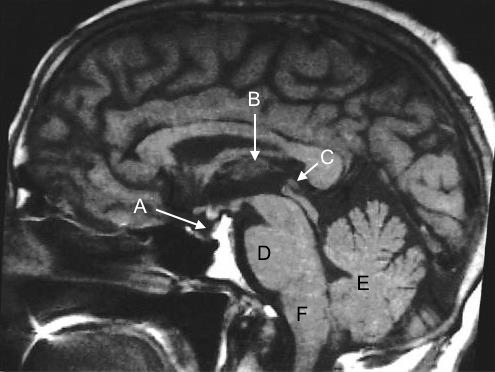
A) A
B) B
C) C
D) D
E) E
F) F
Correct Answer:

Verified
Correct Answer:
Verified
Q87: A 13-year-old boy comes to the office
Q88: A 63-year-old man comes to the physician's
Q89: A 37-year-old woman comes to the office
Q90: A 34-year-old man begins treatment with combination
Q91: A 62-year-old woman comes to the emergency
Q93: A 68-year-old woman comes to the emergency
Q94: A 39-year-old woman is admitted to the
Q95: A 56-year-old previously healthy man comes to
Q96: A 56-year-old man comes to the cardiology
Q97: A 58-year-old man comes to the emergency