Matching
Match the following figures with the most appropriate statement.
<table style="font-family: 'times new roman'; font-size: 11pt; color: #000000; font-weight: normal; left:2px; top:19px; width:744px; height:489px;" summary="An illustration shows 3 graphs and 2 photos.
The graph A with an accompanying photo of the sheep shows the horizontal axis that represents the percentage of lifespan from 0 to 100 with increments of 50. The vertical axis represents the numbers surviving from 0 to 1000 with 10 and 100 in between. The curve starts from 1000 at vertical axis moves steadily and then falls down to 100%. Pink dots are shown along the lines of the curve.
The graph B with an accompanying photo of a desert shrub shows the horizontal axis that represents the percentage of life span from 0 to 100 with increments of 50. The vertical axis represents the numbers surviving from 0 to 1 million with 100 and 10,000 in between. The curve starts from 1million and falls down along the vertical axis to 100 and moves steadily towards the horizontal axis. Pink dots are shown along the lines of the curve.
The graph C with an accompanying photo of a lizard shows the horizontal axis represents the percentage of life span from 0 to 100 with increments of 50. The vertical axis represents the numbers surviving from 0 to 1000 with 10 and 100 in between. A straight line is seen across the graph that begins at 1000 and ends at 100. Pink dots are seen along the line.
The photo D shows a black fly laying eggs on a tomato.
The photo E shows two whales swimming in the water.">
A. 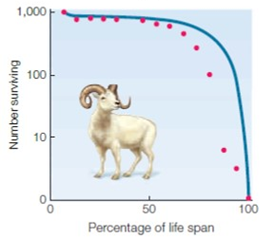
B. 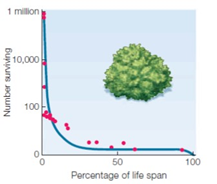
C. 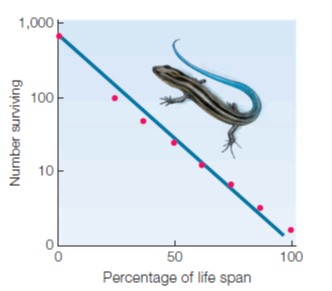
D. 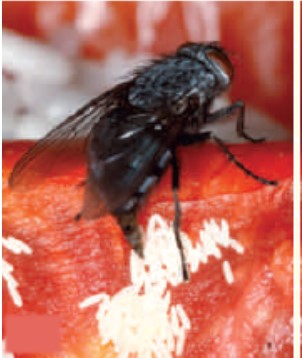
E. 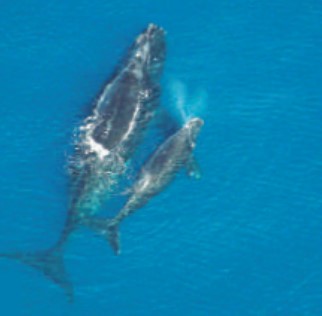
Correct Answer:
Q2: Type II survivorship curves _.<br>A) are characteristics
Q6: It has been estimated that if everyone
Q19: Match the following terms with the
Q19: A flood that washes away an entire
Q21: <img src="https://d2lvgg3v3hfg70.cloudfront.net/TBX8682/.jpg" alt=" During phase
Q27: Density-independent controls over population growth include _.<br>A)
Q31: In which type of population distribution would
Q69: Which is a density-independent factor?<br>A) competition<br>B) predation<br>C)
Q90: An epidemic facilitated by a high, dense
Q93: Typically, members of a cohort are tracked