Multiple Choice
Table 17-23
Two bottled beverage manufacturers (Firm A and Firm B) determine that they could lower their costs, and thus increase their profits, if they reduced their advertising budgets. But for the plan to work, each firm must agree to refrain from advertising. Each firm believes that advertising works by increasing the demand for the firm's product, but each firm also believes that if neither firm advertises, the costs savings will outweigh the lost sales. Listed in the table below are the individual profits for each firm. 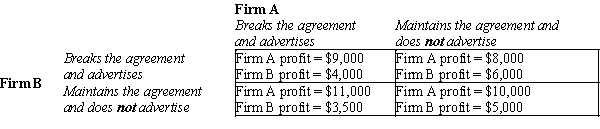
-Refer to Table 17-23. At the Nash equilibrium, how much profit will Firm A earn?
A) $8,000 because firm A will maintain the agreement not to advertise, but firm B will break the agreement and choose to advertise.
B) $9,000 because each firm will break the agreement and choose to advertise.
C) $10,000 because each firm will maintain the agreement and choose not to advertise.
D) $11,000 because firm B will maintain the agreement not to advertise, but firm A will break the agreement and choose to advertise.
Correct Answer:

Verified
Correct Answer:
Verified
Q143: If the output effect from increased production
Q287: Table 17-9<br>The table shows the demand schedule
Q288: Which of the following is correct? When
Q289: Table 17-4<br>The table shows the town of
Q290: The Sherman Antitrust Act<br>A)overturned centuries-old views of
Q291: Figure 17-5. Two companies, ABC and QRS,
Q294: Table 17-27<br>Each year the United States considers
Q295: The Sherman Antitrust Act was passed in<br>A)1836.<br>B)1890.<br>C)1914.<br>D)1946.
Q296: Predatory pricing refers to<br>A)a firm selling certain
Q297: If a market is a duopoly and