Multiple Choice
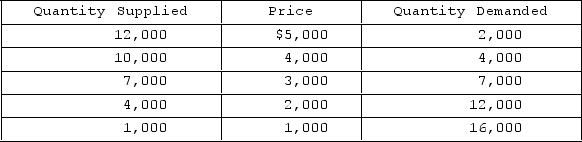 The table gives supply and demand data for a certain elective surgical procedure. If suppliers provide the quantity of health care demanded and insurance pays one-third of the equilibrium price, there would be a resulting allocative
A) efficiency because, at 7,000 units, the marginal cost to society of $3,000 equals the marginal benefit of $3,000.
B) efficiency because, at 12,000 units, the marginal cost to society is $4,000 and the marginal benefit is $1,000.
C) inefficiency because, at 12,000 units, the marginal cost to society is $5,000 and the marginal benefit is $2,000.
D) inefficiency because, at 12,000 units, the marginal cost to society is $2,000 and the marginal benefit is $5,000.
Correct Answer:

Verified
Correct Answer:
Verified
Q169: Which of the following best explains why
Q170: Describe the major spending categories and percentage
Q171: Studies in industrially advanced nations indicate that
Q172: A moral hazard problem arises in the
Q173: A health care organization that contracts with
Q175: The increasing use of part-time and temporary
Q176: The price elasticity of demand for health
Q177: <img src="https://d2lvgg3v3hfg70.cloudfront.net/TB8602/.jpg" alt=" The table shows
Q178: Describe the extent and characteristics of the
Q179: Describe the costs involved when the uninsured