Multiple Choice
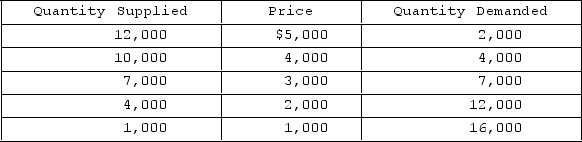 The table gives supply and demand data for a certain elective surgical procedure. If suppliers provide the quantity of health care demanded and insurance pays one-third of the equilibrium price, there would be a resulting allocative
A) efficiency because, at 7,000 units, the marginal cost to society of $3,000 equals the marginal benefit of $3,000.
B) efficiency because, at 12,000 units, the marginal cost to society is $4,000 and the marginal benefit is $1,000.
C) inefficiency because, at 12,000 units, the marginal cost to society is $5,000 and the marginal benefit is $2,000.
D) inefficiency because, at 12,000 units, the marginal cost to society is $2,000 and the marginal benefit is $5,000.
Correct Answer:

Verified
Correct Answer:
Verified
Q270: Which of the following is a provision
Q271: The main purpose of HMOs and PPOs
Q272: Roughly what portion of U.S. total health
Q273: <img src="https://d2lvgg3v3hfg70.cloudfront.net/TB8602/.jpg" alt=" Refer to the
Q274: Employer-provided private health insurance<br>A)is unique to the
Q275: Sam decides to join the Gigantic State
Q277: When the supplier, not the buyer, of
Q278: Asymmetric information in the health care market
Q279: Whole Foods Market's personal wellness accounts for
Q280: A tax subsidy is involved in employer-financed