Multiple Choice
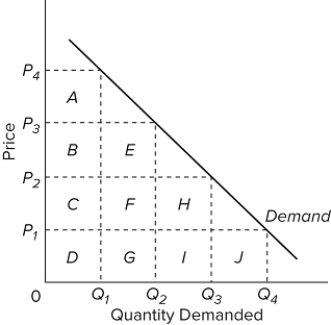 Refer to the above graph. Consider a situation where price decreases from P₂ to P₁. In this price range, demand is relatively
A) inelastic because the loss in total revenue (areas D + G + I + J) is greater than the gain in total revenue (areas C + F + H) .
B) elastic because the loss in total revenue (areas C + F + H) is greater than the gain in total revenue (area J) .
C) elastic because the loss in total revenue (area J) is less than the gain in total revenue (areas C + F + H) .
D) inelastic because the gain in total revenue (area J) is less than the loss in total revenue (areas C + F + H) .
Correct Answer:

Verified
Correct Answer:
Verified
Q365: If a 10 percent increase in the
Q366: Suppose that a 10 percent increase in
Q367: The price elasticity of demand for a
Q368: <img src="https://d2lvgg3v3hfg70.cloudfront.net/TB8602/.jpg" alt=" Refer to the
Q369: The price-elasticity of demand coefficient, Ed, is
Q371: If a college admits only a fixed
Q372: The price elasticity of demand for a
Q373: If the price-elasticity coefficient for a good
Q374: The demand for Cheerios cereal is more
Q375: The main determinant of elasticity of supply