Short Answer
A certain effector protein can be activated by phosphorylation at a key tyrosine residue. An upstream kinase rapidly phosphorylates this tyrosine in the presence of a signal. However, the kinase also phosphorylates and activates a slow-acting phosphatase that can dephosphorylate the phosphotyrosine. Which curve in the following graph would you expect to represent the activity of the effector molecule over time? The input signal is present during the period indicated in gray. The dashed line represents the response in the absence of the phosphatase. 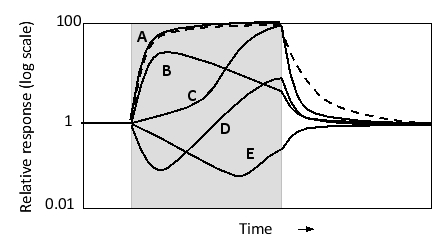
Correct Answer:

Verified
The upstream kinase both acti...View Answer
Unlock this answer now
Get Access to more Verified Answers free of charge
Correct Answer:
Verified
View Answer
Unlock this answer now
Get Access to more Verified Answers free of charge
Q45: In which of the following schematic drawings
Q46: In the following simplified diagram of the
Q47: Cells can adapt to extracellular signal molecules
Q48: Which of the following is NOT part
Q49: Fill in the blank in the following
Q51: Sort the following events to reflect the
Q52: Which of the following molecular mechanisms is
Q53: Which of the following represents the active
Q54: PI 3-kinase ...<br>A) is a membrane-associated tyrosine
Q55: Activated STATs can induce the expression of