Multiple Choice
Scenario 13.2
Assume the following conditions hold.
A) At all banks, excess reserves are zero.
B) The deposit expansion multiplier is 3.
C) The spending multiplier is 5.
D) The initial equilibrium level of national income is $500 billion.
E) The initial equilibrium interest rate equals 6 percent.
F) The investment spending function is as illustrated in the figure below.
Now the Federal Reserve engages in an open market operation by purchasing $1 billion worth of government bonds from private bond dealers, who then deposit the $1 billion in the banks. This acts to lower the equilibrium interest rate by 2 percent.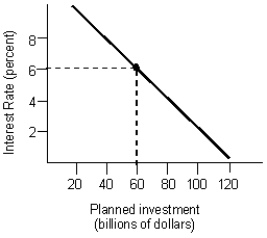
-Refer to Scenario 13.2. What is the ultimate change in the money supply following the open market operation by the Fed?
A) $3 billion
B) $0.33 billion
C) +$1 billion
D) +$2.01 billion
E) +$5.2 billion
Correct Answer:

Verified
Correct Answer:
Verified
Q7: If the U.S.dollar depreciates against the yen
Q8: The quantity of excess reserves in the
Q25: The Federal Reserve (Fed)was created by the
Q44: The Fed controls the money supply to
Q64: Which of the following is true of
Q78: The supply of the U.S.dollar on the
Q86: Suppose Fed's purchase of government bonds results
Q114: A leftward shift in the money demand
Q126: The table given below shows the
Q135: The figure given below depicts the equilibrium