Multiple Choice
Two researchers measured the snout-to-vent (anus) length of Galápagos marine iguanas (lizards) and observed the percent survival of different-sized animals, all of the same age. The graph shows the log snout-vent length (SVL, a measure of overall body size) plotted against the percent survival of these different size classes for males and females. 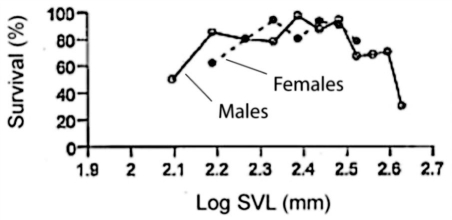 (Data from M. Wikelski and L. Michael Romero. Body size, performance and fitness in Galapagos marine iguanas. Integrative and Comparative Biology 43:376-386 [2003].)
Based on the data in the figure, what type of selection for body size appears to be occurring in these marine iguanas?
A) directional selection
B) stabilizing selection
C) disruptive selection
D) You cannot determine the type of selection from the above information.
Correct Answer:

Verified
Correct Answer:
Verified
Q40: The value of the Hardy-Weinberg equation is
Q41: Harmful mutations occur in both diploid and
Q42: <img src="https://d2lvgg3v3hfg70.cloudfront.net/TB8578/.jpg" alt=" In a very
Q43: Which of the following comparisons illustrates differences
Q44: A population of dark-eyed junco birds became
Q46: A large population of laboratory animals has
Q47: A proficient engineer can easily design skeletal
Q48: A species of moth lays eggs on
Q49: If individuals tend to mate within a
Q50: Imagine a human population with an extremely