Multiple Choice
Use the following information and figure to answer the question.
The sea slug Pteraeolidia ianthina (P. ianthina) can harbor living dinoflagellates (photosynthetic protists) in its skin. These endosymbiotic dinoflagellates reproduce quickly enough to maintain their populations. Low populations of the dinoflagellates do not affect the sea slugs very much, but high populations (> 5 x 10⁵ cells/mg of sea slug protein) can promote sea slug survival.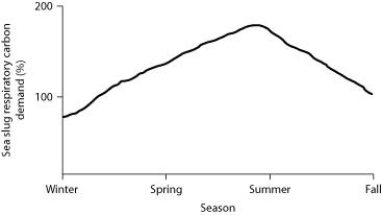
Percent of sea slug respiratory carbon demand provided by indwelling dinoflagellates.
Which of the following would be a potential disadvantage to the sea slugs of housing the dinoflagellates?
A) The CO₂ produced by the dinoflagellates would poison the sea slug.
B) The dinoflagellates would be an energy drain on the sea slug.
C) The sea slugs are exposed to predators when they spend time in the sunlit areas needed by the dinoflagellates.
D) The dinoflagellates will reduce the ability of the sea slugs to move.
Correct Answer:

Verified
Correct Answer:
Verified
Q6: If plaque on teeth is actually a
Q43: Which of the following traits do archaeans
Q46: Use the following information and graph to
Q49: The following question refers to the figure.<br>In
Q49: A fish that has been salt-cured subsequently
Q50: In a hypothetical situation, a bacterium lives
Q52: Data were collected from the heterocysts of
Q54: In prokaryotes, new mutations accumulate quickly in
Q67: When a virus infects a bacterial cell,
Q70: Which of the following describe all existing