Multiple Choice
A metabolic process allowing for anaerobic degradation of benzoate to acetate is diagrammed below. This metabolism can happen because 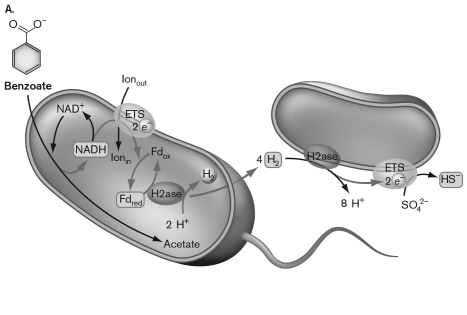
A) benzoate contains a great deal of energy and ATP can be made.
B) the catabolism of benzoate by the cell on the left produces hydrogen that is then used by the cell on the right to reduce sulfate.
C) the catabolism of benzoate by the cell on the left produces hydrogen that is then used by a methanogen.
D) the catabolism of benzoate to acetate releases so much energy that it overcomes the positive G of H2 production.
E) the cell on the left swims away from the H2 that it produces in order to balance the thermodynamics.
Correct Answer:

Verified
Correct Answer:
Verified
Q56: Treponema pallidum, the causative agent of syphilis,
Q57: In amphibolic pathways, enzymes do NOT<br>A) function
Q58: Which of the following pairs is mismatched?<br>A)
Q59: In glycolysis, dihydroxyacetone phosphate is isomerized to
Q60: Clostridium acetobutylicum has been used to produce
Q62: Using the table below, what is
Q63: Not all enzymes are proteins; in some
Q64: Which of the following molecules is responsible
Q65: The catabolism of glucose is central to
Q66: Species of Pseudomonas and Rhodococcus can degrade