Multiple Choice
Energy conservation with conservative forces: A box of mass m is pressed against (but is not attached to) an ideal spring of force constant k and negligible mass, compressing the spring a distance x. After it is released, the box slides up a frictionless incline as shown in the figure and eventually stops. If we repeat this experiment but instead compress the spring a distance of 2x 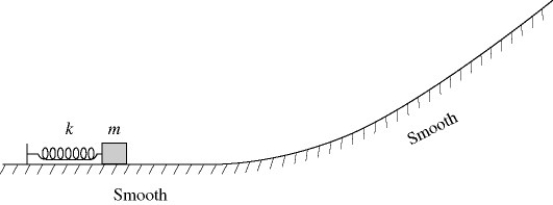
A) the box will go up the incline twice as high as before.
B) just as it moves free of the spring, the box will be traveling twice as fast as before.
C) just as it moves free of the spring, the box will be traveling four times as fast as before.
D) just as it moves free of the spring, the box will have twice as much kinetic energy as before.
E) just before it is released, the box has twice as much elastic potential energy as before.
Correct Answer:

Verified
Correct Answer:
Verified
Q1: Energy conservation with nonconservative forces: A 50.0-kg
Q2: Work-energy theorem: In the figure, two boxes,
Q3: Energy conservation with conservative forces: Swimmers at
Q4: Energy conservation with nonconservative forces: A girl
Q5: Work-energy theorem: A 5.00-kg box slides 4.00
Q7: Energy conservation with conservative forces: It requires
Q8: Work done by variable forces: A force
Q9: Energy conservation with conservative forces: A very
Q10: Power: The work performed as a function
Q11: Energy conservation with conservative forces: An 8.0-m