Solved

A Radiometer Has Two Square Vanes (1.0 cm( 1.0 \mathrm {~cm} By 1.0 cm)1.0 \mathrm {~cm} )

Question 36

Multiple Choice

A radiometer has two square vanes (1.0 cm( 1.0 \mathrm {~cm} by 1.0 cm) 1.0 \mathrm {~cm} ) , attached to a light horizontal cross arm, and pivoted about a vertical axis through the center, as shown in the figure. The center of each vane is 6.0 cm6.0 \mathrm {~cm} from the axis. One vane is silvered and it reflects all radiant energy incident upon it. The other vane is blackened and it absorbs all incident radiant energy. Radiant energy, having an intensity of 300 W/m2300 \mathrm {~W} / \mathrm { m } ^ { 2 } , is incident normally upon the vanes. What is the radiation pressure on the blackened vane? (c=3.0×10⁸ m/s,μ0=4π×10−7 T⋅m/A,ε0=8.85×10−12C2/N⋅m2) \left( c = 3.0 \times 10 ^ { 8 } \mathrm {~m} / \mathrm { s } , \mu _ { 0 } = 4 \pi \times 10 ^ { - 7 } \mathrm {~T} \cdot \mathrm { m } / \mathrm { A } , \varepsilon _ { 0 } = 8.85 \times 10 ^ { - 12 } \mathrm { C } ^ { 2 } / \mathrm { N } \cdot \mathrm { m } ^ { 2 } \right)
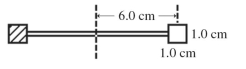
 A radiometer has two square vanes  ( 1.0 \mathrm {~cm}  by  1.0 \mathrm {~cm} )  , attached to a light horizontal cross arm, and pivoted about a vertical axis through the center, as shown in the figure. The center of each vane is  6.0 \mathrm {~cm}  from the axis. One vane is silvered and it reflects all radiant energy incident upon it. The other vane is blackened and it absorbs all incident radiant energy. Radiant energy, having an intensity of  300 \mathrm {~W} / \mathrm { m } ^ { 2 } , is incident normally upon the vanes. What is the radiation pressure on the blackened vane?  \left( c = 3.0 \times 10 ^ { 8 } \mathrm {~m} / \mathrm { s } , \mu _ { 0 } = 4 \pi \times 10 ^ { - 7 } \mathrm {~T} \cdot \mathrm { m } / \mathrm { A } , \varepsilon _ { 0 } = 8.85 \times 10 ^ { - 12 } \mathrm { C } ^ { 2 } / \mathrm { N } \cdot \mathrm { m } ^ { 2 } \right)      A)   1.0 \times 10 ^ { - 10 } \mathrm {~Pa}  B)   1.0 \times 10 ^ { - 7 } \mathrm {~Pa}  C)   1.0 \times 10 ^ { - 8 } \mathrm {~Pa}  D)   1.0 \times 10 ^ { - 6 } \mathrm {~Pa}  E)   1.0 \times 10 ^ { - 9 } \mathrm {~Pa}


A) 1.0×10⁻¹⁰ Pa1.0 \times 10 ^ { - 10 } \mathrm {~Pa}
B) 1.0×10⁻⁷ Pa1.0 \times 10 ^ { - 7 } \mathrm {~Pa}
C) 1.0×10⁻⁸ Pa1.0 \times 10 ^ { - 8 } \mathrm {~Pa}
D) 1.0×10⁻⁶ Pa1.0 \times 10 ^ { - 6 } \mathrm {~Pa}
E) 1.0×10⁻⁹ Pa1.0 \times 10 ^ { - 9 } \mathrm {~Pa}

Correct Answer:

verifed

Verified

Unlock this answer now
Get Access to more Verified Answers free of charge

Related Questions