Multiple Choice
Solve the problem.
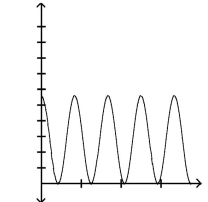
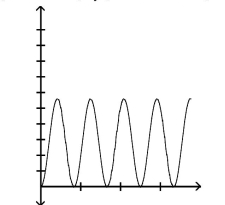
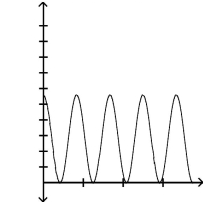
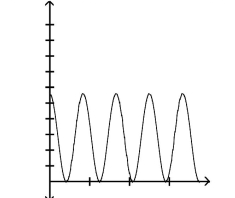
-Suppose that a hair dryer operates on a voltage that can be represented by the relation and that it draws a current represented by the relation , where is time measured in seconds. The power consumed by the appliance is VI. Graph the power in by and use an identity to write the expression for the power in the form , where , and are constants.
A)
by ![Solve the problem. -Suppose that a hair dryer operates on a voltage that can be represented by the relation \mathrm { V } ( \mathrm { t } ) = 160 \cos ( 120 \pi \mathrm { t } ) and that it draws a current represented by the relation \mathrm { I } ( \mathrm { t } ) = 7 \cos ( 120 \pi \mathrm { t } ) , where t is time measured in seconds. The power consumed by the appliance is P = VI. Graph the power in [ 0,0.04,0.01 ] by [ - 200,2000,200 ] and use an identity to write the expression for the power in the form \mathrm { P } = \mathrm { a } \cos ( \mathrm { k } \pi \mathrm { t } ) + \mathrm { d } , where \mathrm { a } , \mathrm { k } , and \mathrm { d } are constants. A) P = 560 \cos ( 240 \pi t ) + 560 [ 0,0.04,0.01 ] by [ - 200,2000,200 ] B) P = 1120 \cos ( 240 \pi t ) + 1120 [ 0,0.04,0.01 ] by [ - 200,2000,200 ] C) \mathrm { P } = - 560 \cos ( 240 \pi \mathrm { t } ) + 560 [ 0,0.04,0.01 ] by [ - 200,2000,200 ] D) P = 560 \cos ( 120 \pi t ) + 560 [ 0,0.04,0.01 ] by [ - 200,2000,200 ]](https://d2lvgg3v3hfg70.cloudfront.net/TB4654/11ecc6ec_2c3e_3aeb_a77c_578a4261f302_TB4654_11.jpg)
B)
by ![Solve the problem. -Suppose that a hair dryer operates on a voltage that can be represented by the relation \mathrm { V } ( \mathrm { t } ) = 160 \cos ( 120 \pi \mathrm { t } ) and that it draws a current represented by the relation \mathrm { I } ( \mathrm { t } ) = 7 \cos ( 120 \pi \mathrm { t } ) , where t is time measured in seconds. The power consumed by the appliance is P = VI. Graph the power in [ 0,0.04,0.01 ] by [ - 200,2000,200 ] and use an identity to write the expression for the power in the form \mathrm { P } = \mathrm { a } \cos ( \mathrm { k } \pi \mathrm { t } ) + \mathrm { d } , where \mathrm { a } , \mathrm { k } , and \mathrm { d } are constants. A) P = 560 \cos ( 240 \pi t ) + 560 [ 0,0.04,0.01 ] by [ - 200,2000,200 ] B) P = 1120 \cos ( 240 \pi t ) + 1120 [ 0,0.04,0.01 ] by [ - 200,2000,200 ] C) \mathrm { P } = - 560 \cos ( 240 \pi \mathrm { t } ) + 560 [ 0,0.04,0.01 ] by [ - 200,2000,200 ] D) P = 560 \cos ( 120 \pi t ) + 560 [ 0,0.04,0.01 ] by [ - 200,2000,200 ]](https://d2lvgg3v3hfg70.cloudfront.net/TB4654/11ecc6ec_32c8_bacc_a77c_b3d93d5fa51a_TB4654_11.jpg)
C)
by ![Solve the problem. -Suppose that a hair dryer operates on a voltage that can be represented by the relation \mathrm { V } ( \mathrm { t } ) = 160 \cos ( 120 \pi \mathrm { t } ) and that it draws a current represented by the relation \mathrm { I } ( \mathrm { t } ) = 7 \cos ( 120 \pi \mathrm { t } ) , where t is time measured in seconds. The power consumed by the appliance is P = VI. Graph the power in [ 0,0.04,0.01 ] by [ - 200,2000,200 ] and use an identity to write the expression for the power in the form \mathrm { P } = \mathrm { a } \cos ( \mathrm { k } \pi \mathrm { t } ) + \mathrm { d } , where \mathrm { a } , \mathrm { k } , and \mathrm { d } are constants. A) P = 560 \cos ( 240 \pi t ) + 560 [ 0,0.04,0.01 ] by [ - 200,2000,200 ] B) P = 1120 \cos ( 240 \pi t ) + 1120 [ 0,0.04,0.01 ] by [ - 200,2000,200 ] C) \mathrm { P } = - 560 \cos ( 240 \pi \mathrm { t } ) + 560 [ 0,0.04,0.01 ] by [ - 200,2000,200 ] D) P = 560 \cos ( 120 \pi t ) + 560 [ 0,0.04,0.01 ] by [ - 200,2000,200 ]](https://d2lvgg3v3hfg70.cloudfront.net/TB4654/11ecc6ec_1d43_1609_a77c_c7e75d12f00d_TB4654_11.jpg)
D)
by
Correct Answer:

Verified
Correct Answer:
Verified
Q48: Perform the indicated operations and simplify
Q49: Find the exact value by using
Q50: Use the fundamental identities to simplify
Q51: For the graph of a circular
Q52: Use identities to find the indicated
Q54: Use a sum or difference identity
Q55: Write the expression in terms of
Q56: Solve the equation for solutions in
Q57: Use a calculator to give the
Q58: Graph the inverse circular function.<br>- <span