Multiple Choice
Solve the problem.
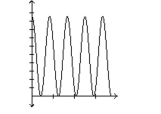
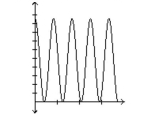
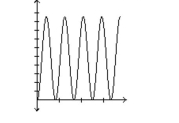
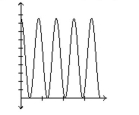
-Suppose that a hair dryer operates on a voltage that can be represented by the relation and that it draws a current represented by the relation , where is time measured in seconds. The power consumed by the appliance is P =VI. Graph th power in [0, 0.04, 0.01] by and use an identity to write the expression for the power in the form , where , and are constants.
A)
by ![Solve the problem. -Suppose that a hair dryer operates on a voltage that can be represented by the relation V ( t ) = 160 \cos ( 120 \pi t ) and that it draws a current represented by the relation I ( t ) = 12 \cos ( 120 \pi t ) , where t is time measured in seconds. The power consumed by the appliance is P =VI. Graph th power in [0, 0.04, 0.01] by [ - 200,2000,200 ] and use an identity to write the expression for the power in the form \mathrm { P } = \mathrm { a } \cos ( \mathrm { k } \pi \mathrm { t } ) + \mathrm { d } , where \mathrm { a } , \mathrm { k } , and \mathrm { d } are constants. A) \mathrm { P } = 960 \cos ( 240 \pi \mathrm { t } ) + 960 [ 0,0.04,0.01 ] by [ - 200,2000,200 ] B) \mathrm { P } = 1920 \cos ( 240 \pi \mathrm { t } ) + 1920 [ 0,0.04,0.01 ] by [ - 200,2000,200 ] C) P = 960 \cos ( 120 \pi t ) + 960 [ 0,0.04,0.01 ] by [ - 200,2000,200 ] D) P = - 960 \cos ( 240 \pi t ) + 960 [ 0,0.04,0.01 ] by [ - 200,2000,200 ]](https://d2lvgg3v3hfg70.cloudfront.net/TB7514/11ed7ae0_5ec2_c8eb_a08b_bf486c37e9f5_TB7514_11.jpg)
B)
by ![Solve the problem. -Suppose that a hair dryer operates on a voltage that can be represented by the relation V ( t ) = 160 \cos ( 120 \pi t ) and that it draws a current represented by the relation I ( t ) = 12 \cos ( 120 \pi t ) , where t is time measured in seconds. The power consumed by the appliance is P =VI. Graph th power in [0, 0.04, 0.01] by [ - 200,2000,200 ] and use an identity to write the expression for the power in the form \mathrm { P } = \mathrm { a } \cos ( \mathrm { k } \pi \mathrm { t } ) + \mathrm { d } , where \mathrm { a } , \mathrm { k } , and \mathrm { d } are constants. A) \mathrm { P } = 960 \cos ( 240 \pi \mathrm { t } ) + 960 [ 0,0.04,0.01 ] by [ - 200,2000,200 ] B) \mathrm { P } = 1920 \cos ( 240 \pi \mathrm { t } ) + 1920 [ 0,0.04,0.01 ] by [ - 200,2000,200 ] C) P = 960 \cos ( 120 \pi t ) + 960 [ 0,0.04,0.01 ] by [ - 200,2000,200 ] D) P = - 960 \cos ( 240 \pi t ) + 960 [ 0,0.04,0.01 ] by [ - 200,2000,200 ]](https://d2lvgg3v3hfg70.cloudfront.net/TB7514/11ed7ae0_63b4_f58c_a08b_c370c04afb8a_TB7514_11.jpg)
C)
by ![Solve the problem. -Suppose that a hair dryer operates on a voltage that can be represented by the relation V ( t ) = 160 \cos ( 120 \pi t ) and that it draws a current represented by the relation I ( t ) = 12 \cos ( 120 \pi t ) , where t is time measured in seconds. The power consumed by the appliance is P =VI. Graph th power in [0, 0.04, 0.01] by [ - 200,2000,200 ] and use an identity to write the expression for the power in the form \mathrm { P } = \mathrm { a } \cos ( \mathrm { k } \pi \mathrm { t } ) + \mathrm { d } , where \mathrm { a } , \mathrm { k } , and \mathrm { d } are constants. A) \mathrm { P } = 960 \cos ( 240 \pi \mathrm { t } ) + 960 [ 0,0.04,0.01 ] by [ - 200,2000,200 ] B) \mathrm { P } = 1920 \cos ( 240 \pi \mathrm { t } ) + 1920 [ 0,0.04,0.01 ] by [ - 200,2000,200 ] C) P = 960 \cos ( 120 \pi t ) + 960 [ 0,0.04,0.01 ] by [ - 200,2000,200 ] D) P = - 960 \cos ( 240 \pi t ) + 960 [ 0,0.04,0.01 ] by [ - 200,2000,200 ]](https://d2lvgg3v3hfg70.cloudfront.net/TB7514/11ed7ae0_6d7c_29dd_a08b_f995ab4dced8_TB7514_11.jpg)
D)
by ![Solve the problem. -Suppose that a hair dryer operates on a voltage that can be represented by the relation V ( t ) = 160 \cos ( 120 \pi t ) and that it draws a current represented by the relation I ( t ) = 12 \cos ( 120 \pi t ) , where t is time measured in seconds. The power consumed by the appliance is P =VI. Graph th power in [0, 0.04, 0.01] by [ - 200,2000,200 ] and use an identity to write the expression for the power in the form \mathrm { P } = \mathrm { a } \cos ( \mathrm { k } \pi \mathrm { t } ) + \mathrm { d } , where \mathrm { a } , \mathrm { k } , and \mathrm { d } are constants. A) \mathrm { P } = 960 \cos ( 240 \pi \mathrm { t } ) + 960 [ 0,0.04,0.01 ] by [ - 200,2000,200 ] B) \mathrm { P } = 1920 \cos ( 240 \pi \mathrm { t } ) + 1920 [ 0,0.04,0.01 ] by [ - 200,2000,200 ] C) P = 960 \cos ( 120 \pi t ) + 960 [ 0,0.04,0.01 ] by [ - 200,2000,200 ] D) P = - 960 \cos ( 240 \pi t ) + 960 [ 0,0.04,0.01 ] by [ - 200,2000,200 ]](https://d2lvgg3v3hfg70.cloudfront.net/TB7514/11ed7ae0_72a7_dd0e_a08b_e79326d230a7_TB7514_11.jpg)
Correct Answer:

Verified
Correct Answer:
Verified
Q47: Find the exact value by using
Q48: For the graph of a circular function
Q49: Solve the equation (x in radians
Q50: Use identities to write the expression
Q51: Complete the sentence so the result
Q53: Use a sum or difference identity
Q54: Verify that the equation is an
Q55: Find the exact value of the
Q56: Use the fundamental identities to find
Q57: Solve the equation for x, where