Multiple Choice
Solve the problem.
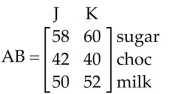
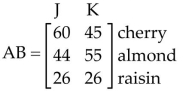
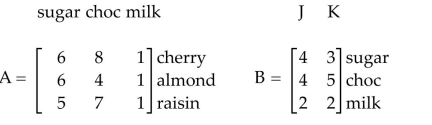
-A company makes three chocolate candies: cherry, almond, and raisin. Matrix A gives the amount Of ingredients in one batch. Matrix B gives the costs of ingredients from suppliers J and K. Multiply The matrices. ![Solve the problem. -A company makes three chocolate candies: cherry, almond, and raisin. Matrix A gives the amount Of ingredients in one batch. Matrix B gives the costs of ingredients from suppliers J and K. Multiply The matrices. A) A B = \left[ \begin{array} { c l } \mathrm { J } & \mathrm { K } \\ 58 & 60 \\ 42 & 40 \\ 50 & 52 \end{array} \right] \begin{array} { l } \text { cherry } \\ \text { almond } \\ \text { raisin } \end{array} B) C) A B = \left[ \begin{array} { c l } \mathrm { J } & \mathrm { K } \\ 45 & 60 \\ 55 & 44 \\ 26 & 26 \end{array} \right]\begin{array} { l } \text { cherry } \\ \text { almond } \\ \text { raisin } \end{array} D)](https://d2lvgg3v3hfg70.cloudfront.net/TB3046/11ecd424_e54d_926c_b625_c7a6e24080cd_TB3046_11.jpg)
A)
B) ![Solve the problem. -A company makes three chocolate candies: cherry, almond, and raisin. Matrix A gives the amount Of ingredients in one batch. Matrix B gives the costs of ingredients from suppliers J and K. Multiply The matrices. A) A B = \left[ \begin{array} { c l } \mathrm { J } & \mathrm { K } \\ 58 & 60 \\ 42 & 40 \\ 50 & 52 \end{array} \right] \begin{array} { l } \text { cherry } \\ \text { almond } \\ \text { raisin } \end{array} B) C) A B = \left[ \begin{array} { c l } \mathrm { J } & \mathrm { K } \\ 45 & 60 \\ 55 & 44 \\ 26 & 26 \end{array} \right]\begin{array} { l } \text { cherry } \\ \text { almond } \\ \text { raisin } \end{array} D)](https://d2lvgg3v3hfg70.cloudfront.net/TB3046/11ecd424_f0d3_66ae_b625_6566030608c4_TB3046_11.jpg)
C)
D) ![Solve the problem. -A company makes three chocolate candies: cherry, almond, and raisin. Matrix A gives the amount Of ingredients in one batch. Matrix B gives the costs of ingredients from suppliers J and K. Multiply The matrices. A) A B = \left[ \begin{array} { c l } \mathrm { J } & \mathrm { K } \\ 58 & 60 \\ 42 & 40 \\ 50 & 52 \end{array} \right] \begin{array} { l } \text { cherry } \\ \text { almond } \\ \text { raisin } \end{array} B) C) A B = \left[ \begin{array} { c l } \mathrm { J } & \mathrm { K } \\ 45 & 60 \\ 55 & 44 \\ 26 & 26 \end{array} \right]\begin{array} { l } \text { cherry } \\ \text { almond } \\ \text { raisin } \end{array} D)](https://d2lvgg3v3hfg70.cloudfront.net/TB3046/11ecd425_00c8_ca11_b625_3f5d7ecad58b_TB3046_11.jpg)
Correct Answer:

Verified
Correct Answer:
Verified
Related Questions
Q1: Solve the problem.<br>-A traveling salesman sells all
Q2: Find the modulo class to which the
Q3: Solve the problem.<br>-Does the associative property
Q4: Determine the sum or difference in the
Q6: Decide whether or not the modulo system
Q7: Determine the sum or difference in the
Q8: Decide whether or not the modulo system
Q9: Decide whether or not the modulo system
Q10: Find all replacements (less than the modulus)
Q11: Determine the sum or difference in the