Multiple Choice
Table 17-8
This table shows the payoffs for a game played between two players, A and B.
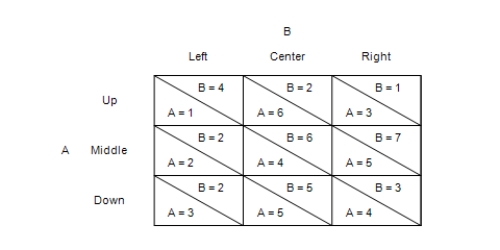
-In a prisoners' dilemma game,
A) the solution when playing the game once will be the same as the solution when the players play the game repeatedly, since agreements cannot be maintained in a prisoners' dilemma.
B) if the players play the game repeatedly, the players can achieve a higher payoff, on average, than when they play the game only once.
C) repeated play will result in a worse outcome for both players than when the game is played only once.
D) the tit-for-tat strategy in repeated play requires players to always select the opposite strategy as their opponent.
Correct Answer:

Verified
Correct Answer:
Verified
Q9: In a prisoner's dilemma situation where firms
Q10: An oligopolist will increase production if the
Q11: As the number of firms in an
Q12: Table 17-2<br>The information in the following
Q13: The problems faced by oligopolies with three
Q15: When firms form a cartel in an
Q16: If two players engaged in a prisoner's
Q17: Table 17-14<br>Suppose that two oil companies -
Q18: In a competitive market, strategic interactions among
Q19: As the number of firms in an