Multiple Choice
Table 17-7
Two companies, Wonka and Gekko, each decide whether to produce a good quality product or a poor quality product. In the figure, the dollar amounts are payoffs and they represent annual profits (in millions of dollars) for the two companies.
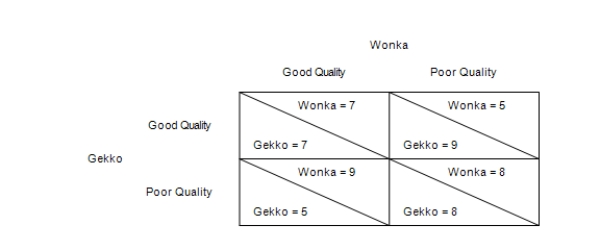
-Refer to Table 17-7. Wonka and Gekko agree to cooperate so as to maximize total profit. If this game is played repeatedly and Wonka uses a tit-for-tat strategy, it will choose a
A) good quality product in the first round and in subsequent rounds it will choose whatever Gekko chose in the previous round.
B) poor quality product in the first round and in subsequent rounds it will choose whatever Gekko chose in the previous round.
C) good quality product in all rounds, regardless of the choice made by Gekko.
D) poor quality product in all rounds, regardless of the choice made by Gekko.
Correct Answer:

Verified
Correct Answer:
Verified
Q134: In some games, the noncooperative equilibrium is
Q135: Game theory is just as necessary for
Q136: Table 17-12<br>Suppose that Angelina and Brad
Q137: Table 17-5<br>The table shows the town
Q138: When an oligopoly market reaches a Nash
Q140: Table 17-2<br>The information in the following
Q141: Table 17-4<br>Only two firms, JKL and
Q142: Table 17-1<br>Imagine a small town in
Q143: If the output effect from increased production
Q144: Suppose that Ngoc and Kalene are duopolists.