Multiple Choice
Table 17-6
Two home-improvement stores (Lopes and HomeMax) in a growing urban area are interested in expanding their market share. Both are interested in expanding the size of their store and parking lot to accommodate potential growth in their customer base. The following game depicts the strategic outcomes that result from the game. Increases in annual profits (in millions of dollars) of the two home-improvement stores are shown in the following figure.
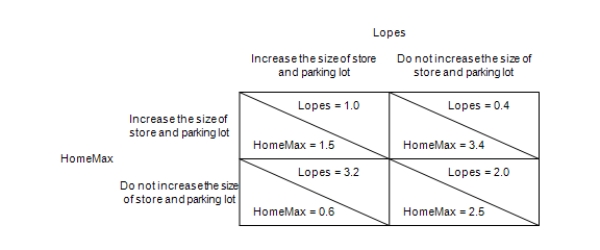
-Refer to Table 17-6. Suppose the owners of Lopes and HomeMax meet for a friendly game of golf one afternoon and happen to discuss a strategy to optimize growth-related profit. If they both agree to cooperate on a strategy that maximizes their joint profits, annual profit will grow by
A) $1.0 million for Lopes and by $1.5 million for HomeMax.
B) $0.4 million for Lopes and by $3.4 million for HomeMax.
C) $3.2 million for Lopes and by $0.6 million for HomeMax.
D) $2.0 million for Lopes and by $2.5 million for HomeMax.
Correct Answer:

Verified
Correct Answer:
Verified
Q55: Which of the following groups or entities
Q56: Table 17-3<br>The table shows the demand
Q57: Scenario 17-2<br><br>Assume that a local telecommunications company
Q58: How does the prisoners' dilemma game apply
Q59: Consider a market served by a monopolist,
Q61: Which of the controversial business practices, resale
Q62: Briefly describe the business practice of tying.
Q63: Ford and General Motors are considering expanding
Q64: Resale price maintenance prevents retailers from competing
Q65: Table 17-13<br>Suppose that Robert and Howard own