Multiple Choice
TABLE 15-9
Many factors determine the attendance at Major League Baseball games. These factors can include when the game is played, the weather, the opponent, whether or not the team is having a good season, and whether or not a marketing promotion is held. Data from 80 games of the Kansas City Royals for the following variables are collected.
ATTENDANCE = Paid attendance for the game
TEMP = High temperature for the day
WIN% = Team's winning percentage at the time of the game
OPWIN% = Opponent team's winning percentage at the time of the game WEEKEND - 1 if game played on Friday, Saturday or Sunday; 0 otherwise PROMOTION - 1 = if a promotion was held; 0 = if no promotion was held
The regression results using attendance as the dependent variable and the remaining five variables as the independent variables are presented below.
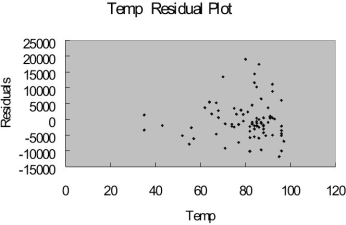
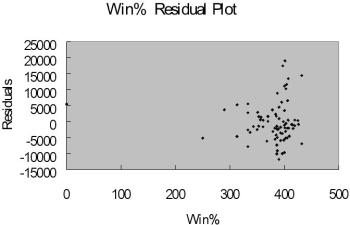
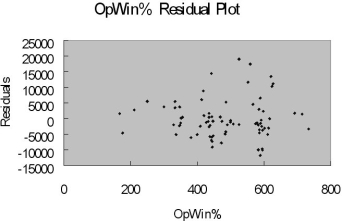
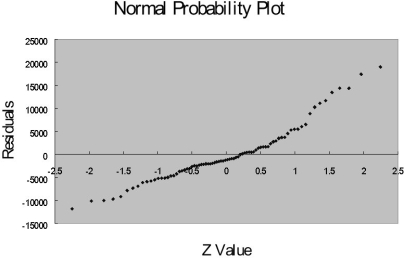
-Referring to Table 15-9, what is the correct interpretation for the estimated coefficient for TEMP?
A) As the high temperature increases by one degree, the paid attendance will increase by 51.70.
B) As the high temperature increases by one degree, the paid attendance will increase by 51.70 taking into consideration all the other independent variables included in the model.
C) As the high temperature increases by one degree, the estimated mean paid attendance will increase by 51.70.
D) As the high temperature increases by one degree, the estimated mean paid attendance will increase by 51.70 taking into consideration all the other independent variables included in the model.
Correct Answer:

Verified
Correct Answer:
Verified
Q22: One of the consequences of collinearity in
Q25: The _ (larger/smaller)the value of the Variance
Q67: TABLE 15-7<br>A chemist employed by a
Q70: TABLE 15-7<br>A chemist employed by a
Q71: Which of the following is not used
Q73: The C<sub>p</sub> statistic is used<br>A) if the
Q74: As a project for his business
Q75: TABLE 15-9<br>Many factors determine the attendance
Q76: The Variance Inflationary Factor (VIF) measures the<br>A)
Q77: Using the Cook's distance statistic Di to