Multiple Choice
Use the following information to answer the question.
Heterobasidion is a basidiomycete that contributes to mortality of trees. Kuhlman isolated 23 strains of Heterobasidion and applied them to 16 seedlings of 10 different tree species. Partial results of this experiment are shown in the table. (From Kuhlman, E. G. 1970. Seedling inoculations with Fomes annosus show variation in virulence and in host susceptibility. Phytopathology 60:1743-1746. https://www.apsnet.org/publications/phytopathology/backissues/Documents/1970Articles/Phyto60n12_1743.PDF)
% mortality of five host species from five Heterobasidion isolates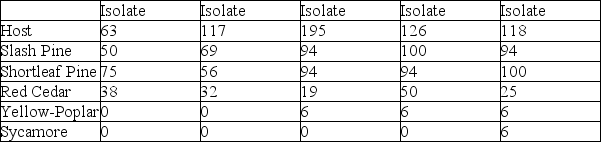
Which of the following conclusions can best be drawn from these results?
A) All tree species are susceptible to Heterobasidion.
B) Heterobasidion strains are equally lethal to all tree species.
C) Heterobasidion strains vary in their effect on tree species.
D) Some strains of Heterobasidion reduce tree mortality.
Correct Answer:

Verified
Correct Answer:
Verified
Q14: All fungi are _.<br>A) symbiotic<br>B) heterotrophic<br>C) flagellated<br>D)
Q23: The most important adaptive advantage associated with
Q32: Some nematode worms suck plant juices from
Q33: Arrange the following in order from largest
Q35: A fungal spore germinates, giving rise to
Q39: Use the following information to answer the
Q40: Use the information to answer the following
Q41: A billionaire buys a sterile volcanic island
Q42: Use the following information to answer the
Q50: At which stage of a basidiomycete's life