Multiple Choice
Use the following information to answer the question.
In an experiment, DNA from the linear form of the bacteriophage Lambda was cut into fragments using the restriction enzyme Hind III. Hind III cuts the Lambda DNA between the adenine nucleotides on the complimentary strands in a specific sequence, as indicated in the diagram, producing eight different size fragments. These fragments are then separated with an electrical current based on size after the DNA fragments are placed in a porous gel, a process called gel electrophoresis.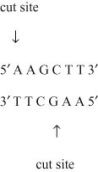
Select an observation that best describes a correct aspect of the two processes of restriction
Digest and gel electrophoresis.
A) When separated on a gel, the pattern of DNA bands will be characteristic of those cut with Hind III; different restriction enzymes will not produce these same fragments.
B) The sequence 5′-AAGCTT-3′ is found eight times in the Lambda genome, and the restriction enzyme Hind III finds each location.
C) If an electrical current is not used, eight separate DNA bands would be visible, but they would not be separated as much as when an electrical current is used.
D) Only the restriction enzyme Hind III can be used to cut Lambda DNA since restriction enzymes are specific to the type of DNA they can cut.
Correct Answer:

Verified
Correct Answer:
Verified
Q1: Transgenic mice are useful to human researchers
Q2: Suppose that a researcher is successful at
Q3: What is the most logical sequence of
Q4: Why is sequencing an entire genome, such
Q8: In 1997, Dolly the sheep was cloned.
Q10: For a particular microarray assay (DNA chip),
Q11: Why might using retroviral vectors for gene
Q15: Which of the following processes helps bacterial
Q48: Which of the following enzymes is required
Q55: Which of the following processes uses labeled