Multiple Choice
Students conducted an experiment to determine the effect of light intensity on the rate of photosynthesis. They punched 40 leaf disks from spinach leaves and used a syringe partially filled with water to pull the gases from the leaf disks so that all leaf disks sunk to the bottom of the syringe. Ten leaf disks from the syringe were placed in each of four cups and covered with 50 ml of the solutions as indicated below. All leaf disks were resting on the bottom of the cups when the experiment began. The volume of liquid in each cup and the temperature of the solutions were held constant. All cups were placed 0.5 meters from the designated light source. A large beaker of water was placed between the light and the cups to act as a heat sink to prevent a change in temperature. At the end of 10 minutes, the number of disks floating in each cup was recorded.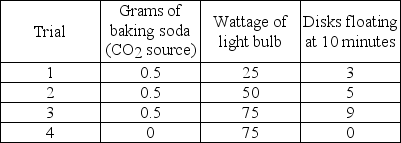
Use your knowledge of the mechanism of photosynthesis and the data presented in the chart to determine which of the statements is a correct explanation for the students' data.
A) Cup 1 had a low rate of photosynthesis because 0.5 grams of baking soda did not provide a sufficient amount of CO₂.
B) Cup 2 had the highest rate of photosynthesis because it had the highest ratio of disks floating to wattage of light.
C) Cup 3 had the same rate of photosynthesis as Cup 1 because they had the same ratio of disks floating to wattage of light.
D) Cup 4 had the lowest rate of photosynthesis because it had the least CO₂.
Correct Answer:

Verified
Correct Answer:
Verified
Q8: Which process is most directly driven by
Q23: Which of the following statements best describes
Q44: Why are C₄ plants able to photosynthesize
Q45: The reducing power for Calvin cycle reactions
Q46: Which of the following events are associated
Q51: In which of the following organisms did
Q52: Which molecule is the final electron acceptor
Q53: Which of the following processes occurs during
Q54: Which of the following processes is most
Q61: The mechanism of photophosphorylation is most similar