Multiple Choice
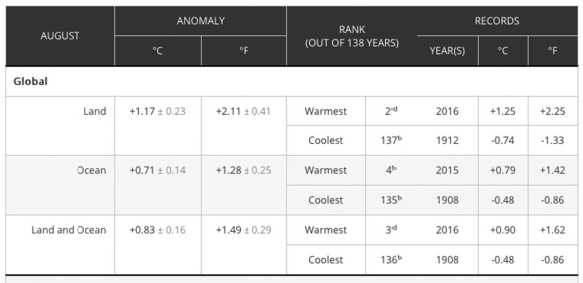 The data in this table describe the average global temperature anomalies measured in August 2017 for Land, Ocean, and Land/Ocean combined. NOAA (the National Oceanic and Atmospheric Administration) defines a temperature anomaly as: "a departure from a reference value or long-term average. A positive anomaly indicates that the observed temperature was warmer than the reference value, while a negative anomaly indicates that the observed temperature was cooler than the reference value." (https://www.ncdc.noaa.gov/monitoring-references/faq/anomalies.php) What can you conclude from these data?
A) Land, Ocean, and Land/Ocean combined all showed negative anomalies.
B) Land, Ocean, and Land/Ocean combined all showed positive anomalies.
C) Land temperature anomalies for 2017 are the highest recorded in 138 years.
D) Land/Ocean combined anomalies for 2017 are the coldest recorded in 138 years.
Correct Answer:

Verified
Correct Answer:
Verified
Q32: The greenhouse effect causes an increase in
Q33: Which question would be investigated by someone
Q34: <b>Scenario</b><br>CO<sub>2</sub> is not the only greenhouse gas
Q35: What can moderate climate by absorbing heat
Q36: Most of the temperate grassland in North
Q38: What level of ecology is concerned with
Q39: What is one important difference between savannas
Q40: Suppose that a group of climate scientists
Q41: Water moves from land to the atmosphere
Q42: In the oceans, global warming has _.<br>A)decreased