Multiple Choice
Intermediate filaments are made from elongated fibrous proteins that are assembled into a ropelike structure.Figure 17-6 shows the structure of an intermediate filament subunit.You are interested in how intermediate filaments are formed, and you create an intermediate filament subunit whose α-helical region is twice as long as that of a normal intermediate filament by duplicating the normal α-helical region while keeping a globular head at the N-terminus and a globular tail at the C-terminus; you call this subunit IFαd.If you were to assemble intermediate filaments using IFαd as the subunit, which of the following predictions describes the most likely outcome? 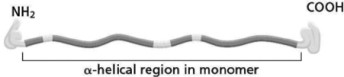 Figure 17-6
A) Filaments assembled using IFαd will interact with different cytoskeletal components.
B) Filaments assembled using IFαd will form dimers that are twice as long as dimers assembled from normal intermediate filaments.
C) Sixteen tetramers assembled from IFαd will be needed for a ropelike structure to form.
D) Dimers of IFαd will form by interactions with the N-terminal globular head and the C-terminal globular tail.
Correct Answer:

Verified
Correct Answer:
Verified
Q44: Place the following in order of size,
Q45: Which of the following statements about organellar
Q46: In the three cell outlines in Figure
Q47: Consider the mechanism by which actin and
Q48: Figure 17-38 shows an electron micrograph of
Q50: For each of the following sentences,
Q51: Microtubules are important for transporting cargo in
Q52: Which of the following statements about microtubules
Q53: Cytochalasin is a drug that caps actin
Q54: All intermediate filaments are of similar diameter