Essay
Carter, Inc. uses a traditional volume-based costing system in which direct labor hours are the allocation base. Carter produces two different products: Product A, which uses 100,000 direct labor hours, and Product B, which uses 300,000 direct labor hours. Carter is considering switching to an ABC system by splitting its manufacturing overhead cost of $1,000,000 across three activities: Design, Production, and Inspection. Under the traditional volume-based costing system, the predetermined overhead rate is $2.50/direct labor hour. Under the ABC system, the cost of each activity and proportion of the activity drivers used by each product are as follows: 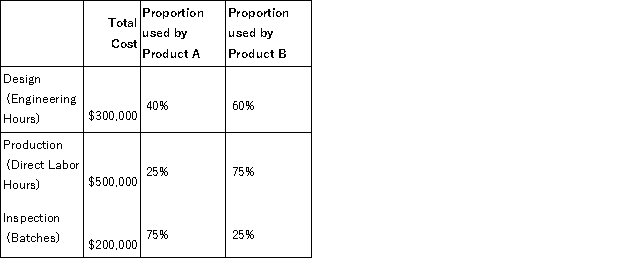 Required:
a. Calculate the indirect manufacturing costs assigned to Product A under the traditional costing system.
b. Calculate the indirect manufacturing costs assigned to Product B under the traditional costing system
c. Calculate the indirect manufacturing costs assigned to Product A under the ABC system.
d. Calculate the indirect manufacturing costs assigned to Product B under the ABC system.
e. Which product is under-costed and which is over-costed under the volume-based cost system compared to ABC?
Correct Answer:

Verified
a. $250,000 = $2.50 × 100,000
b. $750,00...View Answer
Unlock this answer now
Get Access to more Verified Answers free of charge
Correct Answer:
Verified
b. $750,00...
View Answer
Unlock this answer now
Get Access to more Verified Answers free of charge
Q9: Hayden, Inc. produces two different products, Product
Q10: Lynwood, Inc. produces two different products (Product
Q17: Magnolia Company has identified seven activities as
Q19: Lynwood, Inc. produces two different products (Product
Q61: Which of the following involves analyzing the
Q72: A just-in-time (JIT)system is a demand-push system.
Q76: Internal failure costs result from defects that
Q77: An activity cost driver is:<br>A)a measure of
Q98: An activity that is performed for a
Q103: Which of the following sets just-in-time systems